First look
EICMA 2026: TVS RTR 125 LC Walkaround – Is This the Next Apache?
TVS revealed the RTR 125 LC at EICMA 2026: a 125cc liquid-cooled four-valve single with 14.9 PS, a six-speed gearbox and aggressive streetfighter styling. We examine its hardware and whether the design previews the next Apache for India.
- TVS Apache RTR 160 4V ₹1.38 lakh
- TVS Apache RTR 200 4V ₹1.39 lakh
- TVS Raider 125 ₹89,000

Editor & Publisher
TVS Motor Company came to EICMA 2026 with four new products for Europe, and the one that drew the most attention was not electric. The TVS RTR 125 LC is a compact naked built around a 125cc liquid-cooled, four-valve DOHC engine, and it looks less like an entry-level commuter than like a smaller Apache that has spent a season in the gym. TVS calls it an everyday urban sportsbike and describes it as production-ready.
For Indian readers the interesting part is not the A1 licence pitch. It is the face. The rectangular projector headlamp, the mass-forward tank, the exposed trellis and the abbreviated tail amount to a clear design statement, and the obvious question is whether this is a one-off for Europe or a preview of the next Apache for India. That question runs through everything below.
TVS RTR 125 LC: a liquid-cooled 125cc engine
The engine is what separates this motorcycle from the mainstream Indian 125. It is a 125cc single with four valves and twin overhead camshafts, and it is liquid-cooled. TVS quotes 11 kW — 14.9 PS — at 9,000 rpm, and 12 Nm at 7,000 rpm in its EICMA release. A six-speed gearbox and a multiplate assist-and-slipper clutch complete the drivetrain.
Those numbers deserve context. TVS’s own Raider 125 makes 11.4 bhp from a five-valve, air-cooled engine, and the Apache RTR 160 4V makes 17.5 bhp from 159cc. So the new 125 produces close to four-fifths of the 160’s output from a smaller, more expensive engine architecture — with peak power arriving at 9,000 rpm. If you are converting between the units Indian brochures mix, our guide to PS, bhp and horsepower explains why 14.9 PS is about 14.7 bhp and not the same figure.
What liquid cooling actually does is manage temperature. A radiator, coolant pump, thermostat and fan hold the engine at a more stable operating temperature than airflow alone can, which matters when the motorcycle is stationary in traffic, loaded with a pillion, or being held near its power peak. That stability is why manufacturers can build an engine with tighter clearances and a higher specific output. It does not, by itself, promise quicker acceleration or a higher top speed, and TVS has published neither a 0–60 km/h time nor a top speed. The radiator is visible on the show bike behind a wide right-hand shroud, with a black grille and a coolant hose running back toward the pump — an honest piece of hardware rather than a styling panel.
The flip side is cost and complexity: radiator, pump, hoses, coolant, additional weight and another system to service. That trade-off sits at the centre of the Indian question further down.
Aggressive streetfighter design with a new RTR identity
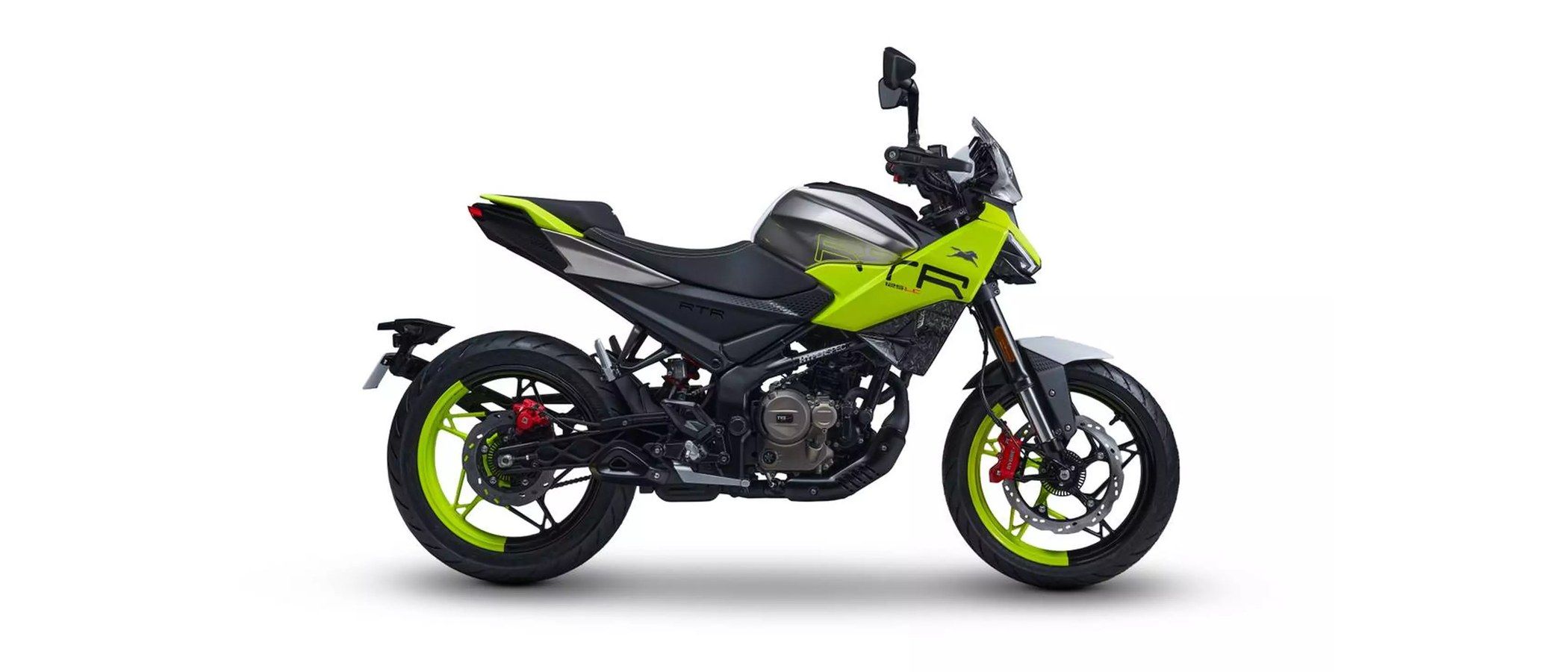
TVS describes the styling as a tank shoulder-blade design with a mass-forward stance, and the description is accurate. The fuel tank is wide at the top and sculpted at the knee, with pronounced extensions that flow into the radiator shrouds. The effect is a motorcycle whose visual weight sits over the front wheel, which is exactly what a streetfighter wants.
The panels around the tank and engine wear a carbon-fibre-look finish. It is a graphic rather than structural carbon, and it should be read as a show-bike finish that may change before a production motorcycle reaches a showroom. The same caution applies to the whole package: TVS calls it production-ready, but colourways, materials and final trim have not been published.
The front end is the boldest part. A rectangular headlamp houses the projector element, framed by a distinctive LED daytime running light signature that wraps around the lamp’s edges, with blocky, ice-cube-style segments that give the face its character. It is a cleaner, more architectural face than the twin-pod arrangements that defined earlier RTR models, and it gives the motorcycle a recognisable identity at a glance. At the rear, TVS fits a tri-split LED tail lamp, and the tail itself is short and kicked up behind a stepped seat.
The details are clear in the walkaround imagery: wide tapered bars with white handguards, bar-end weights, angular mirrors, a small flyscreen above the lamp, and a stubby exhaust exiting low on the right. The seat is stepped for the pillion — sporty in shape, though comfort is not something a photograph can establish.
One naming note worth clearing up. TVS’s release calls the motorcycle the RTR 125 LC, without the Apache prefix. Several outlets have added it, because RTR is the name TVS uses for the naked branch of the Apache family. Until TVS itself uses the Apache name, the safer description is that this is an RTR — and a strong hint at how an Apache could look.
Chassis, suspension and braking hardware
TVS calls the frame a Synchro Stiff chassis, built around a tubular trellis and matched to a cast swingarm. The trellis is exposed rather than hidden behind bodywork, and it is one of the reasons the motorcycle looks more expensive than its capacity suggests.
Front suspension is a 41mm KYB upside-down fork, non-adjustable. At the rear there is an adjustable KYB monoshock, with preload adjustment. An upside-down fork at 125cc is unusual: most motorcycles in this class use a conventional telescopic unit, and the USD fitment is normally reserved for 200cc-and-above sports models. It is the kind of specification that signals intent rather than necessity.
Braking is by a 300mm front disc gripped by a radially mounted ByBre caliper, with a 240mm rear disc and a ByBre caliper behind it. The calipers are finished in red on the show bike, and dual-channel ABS is standard. A radial mount and a 300mm disc are again 200cc-class hardware; combined with the fork, they suggest TVS is not treating this as a parts-bin 125. If the ABS abbreviations are unfamiliar, our explainer on what ABS is covers the difference between single- and dual-channel systems.
The wheels are 17-inch alloys at both ends, carrying a 100/80-17 front tyre and a 140/70-R17 rear — a wider rear than the class norm. The show bike wore Eurogrip rubber, and the rear tyre’s profile is visibly sportier than a commuter 125’s. What TVS has not published is equally important: there is no kerb weight, wheelbase, seat height, fuel-tank capacity or ground clearance in the release, and none is estimated here. Those numbers will decide how the motorcycle behaves and who can ride it comfortably, and they are not yet available.
Built for the European A1 licence category
The A1 licence is the entry rung of the European motorcycle system. It caps the motorcycle at 125cc, 11 kW and a power-to-weight ratio of 0.1 kW per kilogram, and it can be taken from 16 in most countries. Those limits explain the RTR 125 LC’s engine almost exactly: TVS quotes 11 kW, which is precisely the A1 power ceiling.
That is not a coincidence, and it is why the motorcycle makes sense in Europe in a way it does not automatically make sense in India. In the A1 market, a 125 is not necessarily a cheap motorcycle; it is the largest motorcycle a young rider can legally own at 16, and buyers pay for chassis, brakes and equipment. A liquid-cooled engine with a six-speed gearbox, an upside-down fork, a radial caliper, dual-channel ABS, ride modes and a five-inch TFT with Bluetooth and full-screen map mirroring is a credible package in that market. In India, the same specification would be extraordinary at 125cc.
TVS is explicit about the market logic. Peyman Kargar, who leads the company’s international business, described Europe as a key part of the company’s growth plans, with opportunities across electric mobility, performance motorcycles and premium urban transport. The RTR 125 LC arrived alongside three electric scooters for Europe, which makes the intent plain.
Two caveats belong here. “Production-ready” is TVS’s description of the motorcycle, not evidence of completed European type approval or a homologated emissions specification, neither of which the company has published. And there is no price or on-sale date: Autocar India reports that prices and availability are yet to be confirmed. A show unveiling and a dealer launch are different events.
Will the TVS RTR 125 LC launch in India?
There is no announcement, and it is worth being blunt about that. TVS has not confirmed an Indian launch, a price or a timeline, and Autocar India reports that neither the RTR 125 LC nor the M1S scooter appears headed to India for now, though TVS could decide otherwise next year. That is reporting, not a company commitment.
The reason is arithmetic. A liquid-cooled DOHC engine, a six-speed gearbox, an upside-down fork, a radial caliper, a TFT display and dual-channel ABS all cost money, and the Indian 125cc segment is built on price. TVS’s own Raider 125 is catalogued between ₹89,000 and ₹1.11 lakh ex-showroom. The Apache RTR 160 4V starts around ₹1.38 lakh and makes 17.5 bhp. A premium 125 priced anywhere near the 160 would invite an obvious question from a buyer: why not the bigger engine?
That is the trap. Priced low enough to undercut the 160, the RTR 125 LC would need heavy localisation, and localising away the liquid cooling, the USD fork and the TFT would leave a motorcycle that no longer resembles the one in Milan. Priced high enough to keep the hardware, it competes with TVS’s own 160 and 200. The Indian market has also never rewarded a 125 for output alone: the Raider’s appeal is 60 kmpl and a low entry price, not a 9,000 rpm power peak.
TVS is good at frugal engineering, and that skill points toward a different outcome: keep the design language, adapt it to the existing air-cooled 125 or the 160 platform, and leave the expensive chassis hardware for Europe. That is speculation, not a plan the company has disclosed. But it is the route that would let Indian buyers see this face without paying for an engine architecture the segment does not reward.
Could this be the design direction for future TVS Apache bikes?
This is where the RTR 125 LC becomes more than a European homologation exercise. Strip away the 125cc engine and the motorcycle is a coherent design study for a naked Apache: a rectangular projector headlamp with a vertical DRL signature, a mass-forward tank with shoulder extensions, an exposed trellis, a stepped seat and a short, high tail. It is the same visual grammar the Apache RTR line has been moving toward, executed more sharply.
Compare it with the current range. The Apache RTR 200 4V carries a more conventional headlamp and a softer tank-to-seat transition. The Apache RTR 310 is the most aggressive Apache on sale, with a sharply cut tank and a compact tail, and the RTR 125 LC reads as a further step in that direction rather than a retreat from it. The lighting signature is the element most likely to transfer: a family face is cheaper to carry across models than a whole chassis, and it is what gives a range recognition in traffic.
The tank extensions and the short tail are the next most transferable ideas. Both are styling changes rather than engineering ones, and both would suit a future RTR 160 or 200 without demanding a new engine. The USD fork, radial caliper and liquid cooling are the parts that would be harder to justify in India on cost grounds, which is why the design and the hardware should be judged separately.
None of this is a company statement. TVS has said nothing about a future Apache wearing this face, and show-bike panels can change before production. The honest reading is that the RTR 125 LC demonstrates a design direction TVS is clearly capable of, in a market where it can afford to build it. Whether that direction reaches India is a product decision the company has not made public.
TVS RTR 125 LC – our first impressions
As a piece of engineering, the RTR 125 LC is the most interesting 125 at EICMA this year. A liquid-cooled four-valve engine, a six-speed gearbox with an assist-and-slipper clutch, an upside-down KYB fork, a radial ByBre caliper and a TFT display is a serious specification for the class, and the styling is confident enough to carry it. It gives TVS a credible answer to the premium A1 motorcycles that European buyers already have.
As an Indian proposition, it is a question rather than an answer. The hardware is expensive, the segment is price-sensitive, and TVS already sells a strong 160 for less than a premium 125 would plausibly cost. The most valuable export from this project may turn out to be the design language rather than the motorcycle itself.
What we cannot tell you is how it rides. MotoSutra has not ridden the RTR 125 LC, and nothing in the launch material offers ride impressions. Kerb weight, seat height, tank range, suspension calibration and real-world economy are all unpublished, and each of them will matter more to an owner than the peak power figure. A specification sheet can establish what a motorcycle is; only a road can establish what it does.
Would you like to see this aggressive design language on the next TVS Apache in India? Let us know in the comments.
TVS RTR 125 LC specifications
| Specification | As published by TVS |
|---|---|
| Engine | 125cc, four-valve, liquid-cooled DOHC single |
| Maximum power | 11 kW (14.9 PS) at 9,000 rpm |
| Maximum torque | 12 Nm at 7,000 rpm |
| Gearbox | Six-speed |
| Clutch | Multiplate assist-and-slipper |
| Frame and swingarm | Synchro Stiff chassis — trellis frame, cast swingarm |
| Front suspension | 41mm KYB upside-down fork, non-adjustable |
| Rear suspension | KYB monoshock, adjustable (preload) |
| Front brake | 300mm disc, radially mounted ByBre caliper |
| Rear brake | 240mm disc, ByBre caliper |
| ABS | Dual-channel |
| Wheels | 17-inch alloy, front and rear |
| Tyres | 100/80-17 front, 140/70-R17 rear |
| Instrumentation | Five-inch TFT, Bluetooth, full-screen map mirroring |
| Lighting | Rectangular LED projector headlamp with DRL, tri-split LED tail lamp |
| Rider aids | Ride modes |
| Kerb weight, seat height, tank capacity, mileage, top speed | Not published |
| Price and availability | Not announced |
| India launch | Not announced |
The figures above are TVS’s own, published with the EICMA unveiling on 3 November 2026. The blank rows are blank because the company has not published those numbers — they are not estimates, and they should not be filled in from another market’s motorcycle.
Frequently asked questions
Is the TVS RTR 125 LC liquid-cooled?
Yes. It uses a 125cc, four-valve, DOHC single-cylinder engine with liquid cooling, and the radiator sits behind a wide right-hand shroud rather than being tucked out of sight. That makes it an unusual proposition at 125cc, where most Indian-market equivalents — including TVS’s own Raider 125 — rely on air cooling with an oil cooler.
How much power does the TVS RTR 125 LC produce?
TVS quotes 11 kW, or 14.9 PS, at 9,000 rpm and 12 Nm of torque at 7,000 rpm. In imperial units that is about 14.7 bhp. It is a high specific output for a 125, and it sits exactly on the 11 kW ceiling that defines the European A1 licence category.
Does the TVS RTR 125 LC have a six-speed gearbox?
Yes. The engine drives through a six-speed gearbox and a multiplate assist-and-slipper clutch, which is more transmission hardware than the Indian 125cc class typically receives. TVS has not published ratios, final-drive gearing or a claimed top speed.
Will the TVS RTR 125 LC launch in India?
TVS has not announced an Indian launch, price or timeline. The company presented the motorcycle as a European A1 model, and Autocar India reports that neither it nor the M1S scooter appears headed to India for now, though TVS could decide otherwise later. Any Indian arrival would also have to clear a pricing problem, because a premium 125 would land near the Apache RTR 160 4V.
Is the TVS RTR 125 LC related to the Apache series?
It shares the RTR name and the naked streetfighter formula that defines the Apache RTR line, and several outlets have therefore called it the Apache RTR 125 LC. TVS’s own press release names it simply the RTR 125 LC. The company has not described it as an Apache, and it is not part of the Indian Apache range on sale today.