Specs & analysis
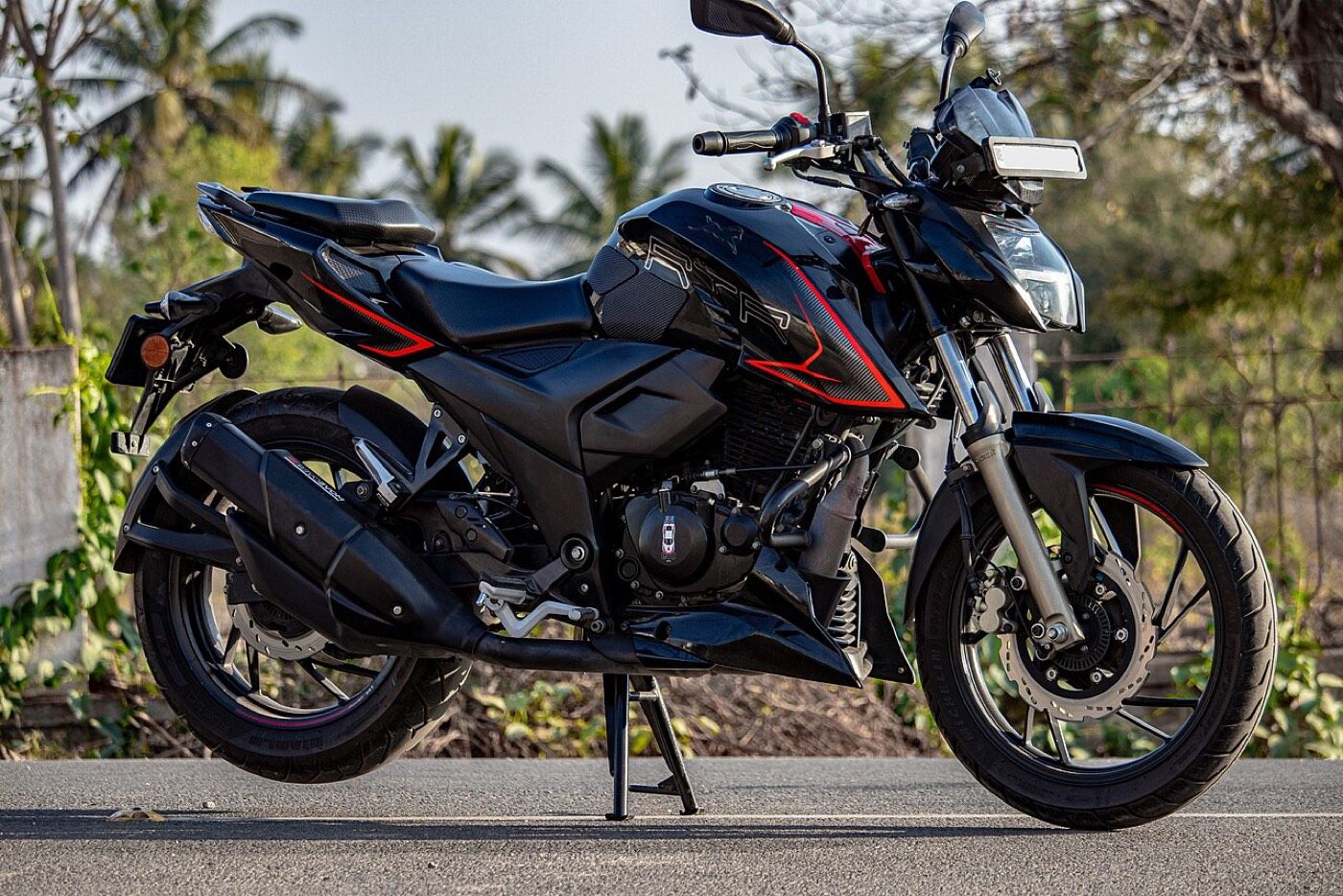
2026 TVS Apache RTR 310 Review: Similar, But Better to Ride
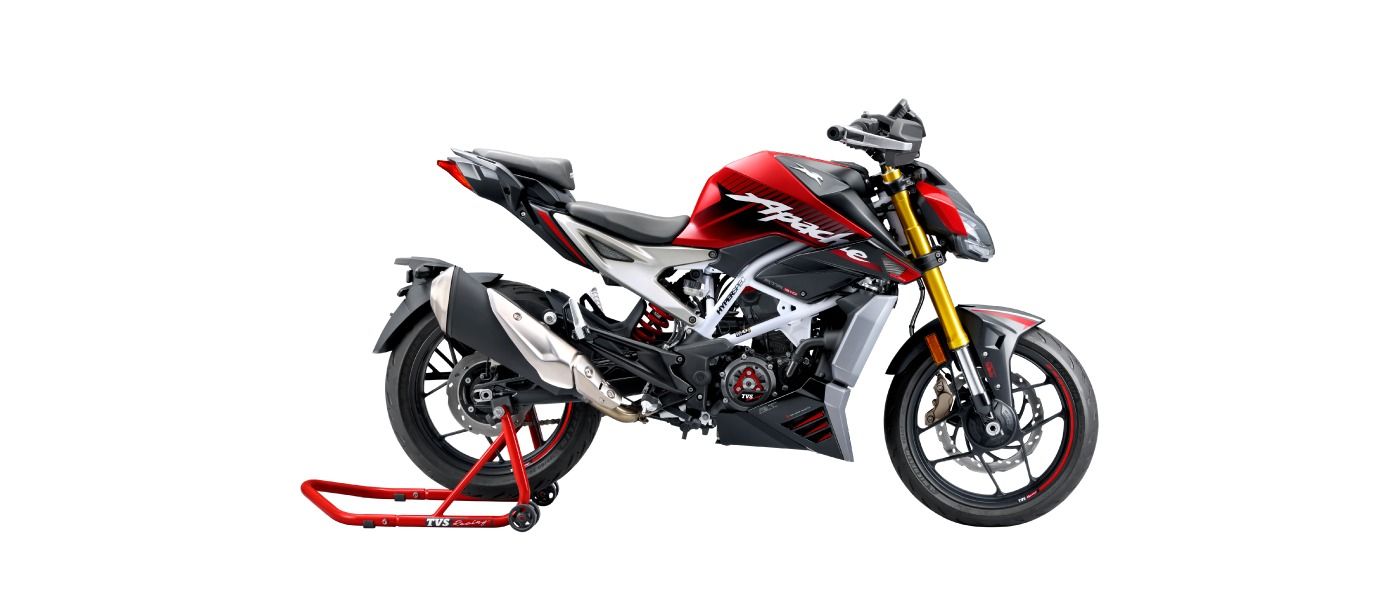
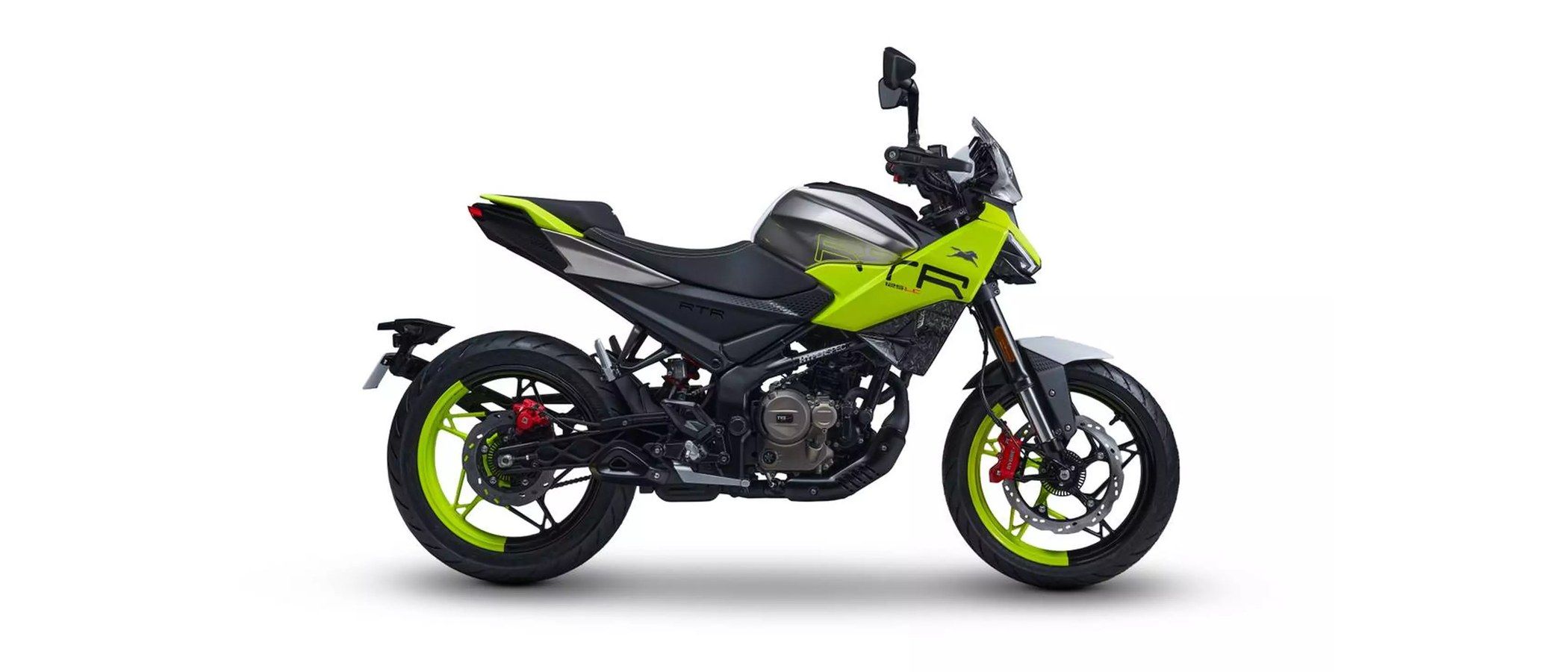
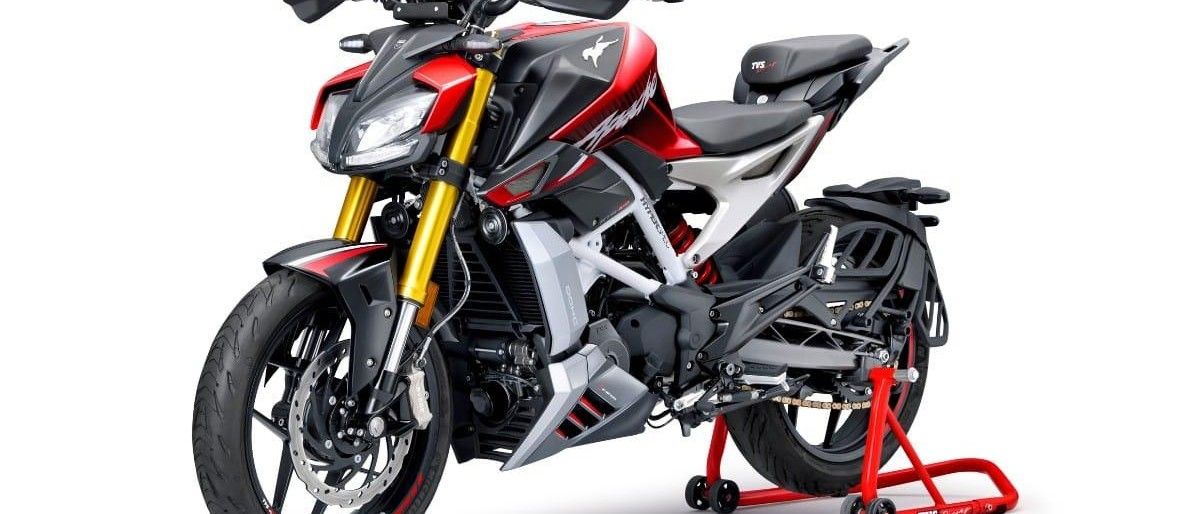
2026 TVS Apache RTR 310 review: the current bike brings a smarter throttle map, taller gearing and an optional electronics suite with drag torque control. This assessment covers the road and circuit impressions from the manufacturer’s first-ride programme, the historical launch prices and whether the top BTO kit is worth it.
- TVS Apache RTR 310 ₹2.3 lakh

Editor & Publisher
MotoSutra editorial assessment
4.3/5
Overall score across 6 rated dimensions
MotoSutra editorial rating: 4.3 out of 5
Lowest rated
Efficiency
3.9/5
Mileage, range & running costs
- Performance Power, acceleration & riding dynamics 4.4/5 Very strong
- Features Equipment & rider features 4.5/5 Excellent
- Design Styling, ergonomics & presence 4.2/5 Very strong
- Safety Build quality, safety equipment & ratings 4.4/5 Very strong
- Efficiency Mileage, range & running costs 3.9/5 Good
- Comfort Ride quality & long-distance comfort 4.2/5 Very strong
The Apache RTR 310, as it enters 2026, is the same sharp naked made easier to live with: the last update’s throttle map and taller gearing are real fixes, and the chassis remains one of the most engaging in the class. Buy the base or quickshifter version; the Dynamic Pro kit is for technology enthusiasts, not value hunters.
MotoSutra editorial rating on a 5-point scale. Rated across 6 dimensions; unscored dimensions are omitted.
TVS has been updating its 310cc platform for so long that the changes have become a kind of annual service. The faired Apache RR 310 arrived in 2017; the naked Apache RTR 310 followed in 2023; and almost every year since, TVS has found something to alter. The motorcycle reviewed here is the updated RTR 310 that TVS has carried into 2026. Its last mechanical and electronic revision was the update that precedes the 2026 model year; TVS has not announced a separate 2026 update, and nothing below should be read as one.
That is not a complaint. The RTR 310 was already one of the sharpest, most feature-dense nakeds in the 300cc class. Its problem was manners. The old bike was so eager at the throttle that a commute felt like a negotiation, and its short gearing kept the engine busy at exactly the speeds where a rider wants calm. TVS has addressed both, added a layer of electronics, and left the chassis alone. The result is not a new Apache. It is a more complete one.
Basis of assessment: this review draws on TVS’s first-ride programme for this specification and the manufacturer’s published specifications. MotoSutra has not independently instrument-tested this motorcycle; the 4.3/5 score is an editorial assessment, not independent test data.
Status, 6 November 2026: TVS has not announced a new mechanical or electronic update since the specification reviewed here was introduced. The RTR 310 described here remains the current specification, and the introductory launch prices in this article remain historical reference points rather than today’s quotation.
What changed on the updated TVS Apache RTR 310?
The changes fall into three groups: one mechanical, one calibration, and a long list of electronic and cosmetic additions. The mechanical change is the final drive. The calibration change is the throttle map. Everything else is either a new part, a new colour, or a feature that was previously unavailable.
| Change | What it does |
|---|---|
| Revised throttle mapping (standard, all modes) | Reads throttle position and the rate at which the rider opens it, then shapes torque delivery accordingly |
| Revised final drive (standard) | Adopts the RR 310’s smaller rear sprocket, four teeth fewer than before |
| Drag Torque Control (Dynamic Pro kit) | Adds a small amount of engine torque on hard downshifts to reduce rear-wheel lock |
| Cornering Drag Torque Control (Dynamic Pro kit) | The same intervention, with lean angle taken into account |
| Cornering traction control (Dynamic Pro kit) | Manages rear grip according to lean angle |
| Cornering ABS (Dynamic Pro kit) | ABS calibrated for braking while leaned over |
| Wheelie control and rear lift-off protection (Dynamic Pro kit) | Limits front-wheel lift under acceleration and rear-wheel lift under braking |
| Cornering cruise control (Dynamic Pro kit) | Holds a set speed through a bend |
| Launch control (Dynamic Pro kit) | Holds engine speed for a consistent hard start in Track mode |
| Keyless start and ride (Dynamic Pro kit) | Key fob starting and steering lock, with no key barrel |
| Sequential LED indicators (standard) | Five-LED sequential turn signals |
| Transparent clutch cover (standard) | A clear cover over the clutch basket |
| Knuckle guards (standard) | New handguards |
| New colours and graphics (optional) | Fiery Red and Sepang Blue join the range |
Two things are easy to miss in that table. The first is that the throttle map and the final drive are the only changes that affect every bike; the electronic headline acts are all part of the most expensive kit. The second is how much of the RTR 310’s appeal was already there. The trellis frame, the 41 mm upside-down fork, the radial front caliper, the Michelin Road 5 tyres, the five-inch TFT and the five ride modes all carry over. TVS has not rebuilt the motorcycle. It has corrected it.
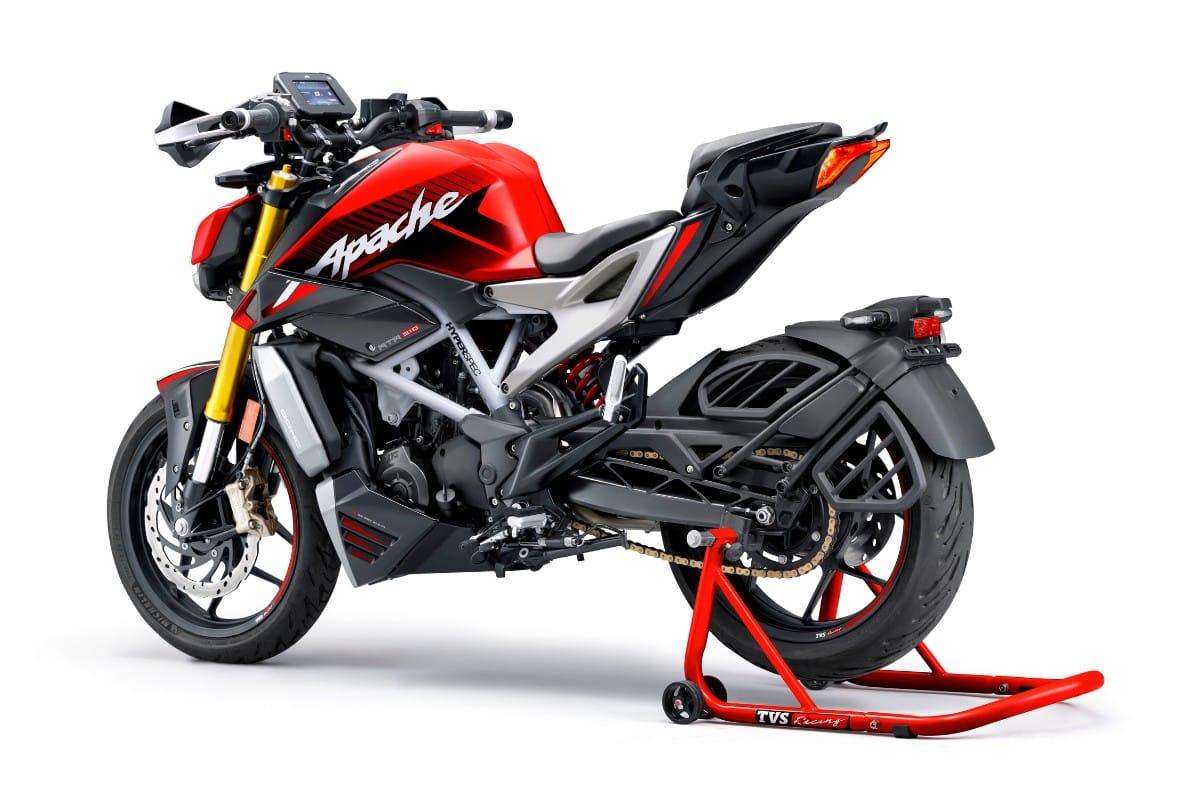
Engine and performance: more refined, still exciting
The engine is the same 312.12cc reverse-inclined single, and TVS has not chased the RR 310’s higher output. The naked makes 35.6 PS at 9,700 rpm — 35.1 bhp, if you prefer the imperial unit — and 28.7 Nm at 6,650 rpm in Sport and Track; in Urban and Rain it is trimmed to 27.1 PS and 27.3 Nm. The faired RR 310 makes 38 PS and 29 Nm. That gap is deliberate: the RR is the faired flagship, the RTR is the street bike, and TVS wants a reason for both to exist.
On the road, the difference between the old and new RTR is not in the peak numbers. It is in the first few degrees of throttle. The old map delivered torque almost as soon as the twist grip moved, which made the bike feel alive but also made it tiresome in traffic. The new map reads both how far the throttle is open and how quickly it is being opened. Open it gently and the response is gentle, even in Sport. Open it quickly and the engine wakes up with the old urgency. The result is a bike that can be calm without being switched into a different mode.
TVS also claims that below about 4,000 rpm the RTR now makes more torque than the RR 310, which is plausible given the RTR’s state of tune and the new final drive. What is certain is that the engine still loves to rev. The mid-range is strong, the top end is willing, and the limiter arrives with a proper single-cylinder bark. It is not a smooth engine, and TVS has not pretended otherwise: the vibrations that used to come through the seat, tank and footpegs above 5,000–6,000 rpm are still there. They are softer than before — softened enough that they read as character rather than complaint — but a rider who wants a turbine-smooth tourer should look elsewhere.
2026 Apache RTR 310 specifications
| Specification | TVS Apache RTR 310 (2026) |
|---|---|
| Engine | 312.12cc liquid-cooled single, four valves |
| Max power | 35.6 PS at 9,700 rpm (Sport/Track); 27.1 PS at 7,500 rpm (Urban/Rain) |
| Max torque | 28.7 Nm at 6,650 rpm (Sport/Track); 27.3 Nm at 6,600 rpm (Urban/Rain) |
| Gearbox | Six-speed with assist-and-slipper clutch |
| Kerb weight | 169 kg |
| Seat height | 800 mm |
| Ground clearance | 180 mm |
| Fuel tank | 11 litres |
| Claimed mileage | 30 km/l (Urban/Rain); 28 km/l (Sport/Track/SuperMoto) |
| Top speed | 150 km/h (claimed) |
| 0–100 km/h | 7.19 seconds (claimed) |
| Front brake | 300 mm disc, radial caliper |
| Rear brake | 240 mm disc |
| Tyres | 110/70 R17 front, 150/60 R17 rear, Michelin Road 5 |
Specifications are from TVS’s official Apache RTR 310 page; power and torque vary by riding mode.
TVS claims 30 km/l in Urban and Rain and 28 km/l in Sport, Track and SuperMoto. MotoSutra has not independently measured fuel economy, so treat those as claims rather than independently verified numbers. The 11-litre tank is not large; at the claimed figures the range is roughly 310–330 km, which is enough for a week of commuting but not for a long tour without planning. The engine’s willingness to rev is the bigger obstacle to economy than any mapping choice.
Improved throttle response and revised gearing
The throttle change is the one that will matter most to anyone who rides in traffic. A conventional throttle map responds to position: a given opening produces a given torque. TVS’s new map also responds to speed of movement. A slow, small opening produces a soft response; a quick opening produces a sharp one. The bike is effectively reading intent as well as input.
That sounds like a small calibration detail. It is not. It is the difference between a motorcycle that feels agitated at 30 km/h and one that feels composed, without losing the snap when the road opens. The old RTR’s problem was never a lack of performance; it was that the performance arrived before the rider had asked for it. The new map lets the rider ask first.
The gearing change works in the same direction. The RTR used to run a noticeably larger rear sprocket than the RR 310. The last update adopted the RR’s smaller unit, four teeth fewer. A smaller rear sprocket lowers engine speed for a given road speed and stretches each gear. On a bike that was already short-geared, that is a small change with a disproportionate effect: the engine is less frantic at 80–100 km/h, first and second are less abrupt, and the bike feels less like it is always asking for another gear. It is still short-geared by the standards of the class, and that is deliberate — the RTR is a street bike, not a tourer.
Would the taller final drive blunt the bottom end? On paper, a little. In practice, the new map and the engine’s low-end output cover it. TVS says the RTR now has better sub-4,000 rpm torque than the RR 310, and the launch first-ride reports support the claim: the bike pulls cleanly out of slow corners and does not need to be revved to make progress. The fast circuit’s long uphill section, which exposes short-geared bikes, was not a problem; the RTR held its speed and kept pulling.
Electronic riding aids and new technology
TVS has packed the RTR 310 with one of the most comprehensive electronics packages in the class, but the packaging is important. The base and quickshifter versions get the new map, the new gearing, the TFT, the LED headlamp, traction control, basic cruise control and dual-channel ABS. The full suite — drag torque control, cornering traction control, cornering ABS, wheelie control, rear lift-off protection, cornering cruise control, launch control and keyless start — is in the Dynamic Pro kit.
Drag Torque Control
A slipper clutch is designed to stop the rear wheel from hopping when you downshift aggressively. It does most of the job, but not all of it: if you drop two gears and release the clutch quickly, the rear tyre can still chirp as engine braking overwhelms the available grip. Drag torque control intervenes in that moment by adding a small amount of fuel and torque, reducing the speed difference between the gearbox and the rear wheel. The result is a less dramatic deceleration and a more settled chassis. On the road, most riders will never notice it. On a track, with the bike leaned over and the clutch released quickly, it is the difference between a slide and a shrug.
Cornering aids
Cornering traction control and cornering ABS use lean angle to decide how much intervention is appropriate. In practice, that means the electronics are less likely to cut in when the bike is upright and more likely to help when it is leaned over on a wet road. Cornering cruise control is a niche feature — it holds a set speed through a bend — but it is the kind of thing that makes a long sweep more relaxing. Wheelie control and rear lift-off protection are track-day toys that also earn their keep on a bumpy road.
Launch control and keyless start
Launch control is straightforward: select Track mode, hold the clutch, open the throttle fully, and the electronics hold the engine at about 7,200 rpm. Release the clutch and the bike manages the launch. It is not a feature most owners will use often, but it is a genuine performance aid and it adds to the sense that this is a special motorcycle. Keyless start and ride is part of the same kit: a fob, a button, and no key barrel. It is convenient, and it removes one more thing to scratch. It is also the clearest example of how TVS has structured the options: the feature is not standard, and a buyer who wants it has to buy the whole Dynamic Pro package.
The quickshifter
The quickshifter is a carry-over, but it remains one of the best reasons to buy this bike. It works both up and down, it is smooth at part throttle as well as full throttle, and it makes the six-speed gearbox feel more expensive than it is. It is standard on the quickshifter version and absent from the base — a strange place to draw the line, because it changes the riding experience more than most of the electronic aids.
Ride and handling: comfortable on the road, fun on the track
The chassis is unchanged, and that is good news. The trellis frame, the 41 mm upside-down fork, the radial front caliper and the Michelin Road 5 tyres were already a strong package. At 169 kg, the RTR is light enough to feel immediate at the bars, and the 800 mm seat height makes it accessible to a wide range of riders. The riding position is sporty but not committed: wide bars, a slight forward lean, and footpegs that are rear-set enough to feel purposeful without folding a tall rider in half.
On the road, the bike turns in quickly and stays stable through the corner. The wide bars give enough leverage to place the front wheel precisely, and the Michelin Road 5s are a sensible choice for Indian roads — they warm up quickly and cope with broken surfaces better than a track-biased tyre would. The BTO Dynamic kit’s fully adjustable suspension was set soft for the road ride, and it dealt with the city’s broken surfaces comfortably. That is the right compromise for a bike that will spend most of its life on Indian roads.
At 180 mm, ground clearance is generous for a sports naked, and the narrow waist makes the bike easy to manage at a standstill. The pillion seat is short and stepped, and the tail is compact; two-up comfort is clearly not the priority.
Track performance: fun, but not a dedicated track machine
The circuit was fast, with a long uphill section, and the RTR was happy there. The short gearing that helps in the city also helps out of slow corners, and the quickshifter keeps the engine in its sweet spot. The chassis is neutral and confidence-inspiring; it does not demand a particular style, and it rewards a rider who is still learning to carry speed. The bike is easy to ride quickly, which is a different and more useful quality than being fast.
But it is not a track bike. The footpeg feelers touch down early, and once they do, the sound is startling enough to break concentration. Removing them buys a little more lean, but the pegs themselves still ground. More rear preload raises the ride height and helps, and adding damping to the BTO suspension for the track was necessary — the road-soft setting was quickly overwhelmed. Even then, the bike is not as fast as a KTM 390 Duke around a circuit, and TVS does not claim it is.
The ergonomics also limit track use. There is not much room to move back in the seat, and when you tuck in, the TFT is close to the helmet. On the road, that same compact layout is a virtue; on the track, it is a reminder that this is a street bike. Buy it for the road, enjoy the occasional track day, and do not expect it to replace a dedicated track machine.
Features and equipment
The five-inch TFT is bright and legible, with ride-mode, traction-control and lap-timer displays; it is the same unit that has been on the bike since launch, and it remains one of the better screens in the class. The adaptive Bi-LED headlamp is excellent — one of the best LED units in the class — and the sequential LED indicators are a small but effective visual upgrade. The transparent clutch cover is a cosmetic flourish that lets you see the clutch basket; it does nothing for performance, but it makes the bike feel more special.
Basic cruise control is standard, which is unusual at this price, and traction control is standard too. The Dynamic kit adds the adjustable suspension, tyre-pressure monitoring and a brass-coated chain. The base bike is not stripped: it gets the TFT, the LED headlamp, dual-channel ABS, traction control and cruise control. What it does not get is the electronic layer that makes the RTR 310 a conversation piece.
2026 TVS Apache RTR 310 price and variants
TVS introduced this specification with introductory launch prices that were, for once, lower than the outgoing model’s: the base bike was ₹10,000 cheaper than before. TVS has not announced a separate 2026 launch price; the figures below are the launch prices for this specification, not a 2026 quotation.
Launch prices and BTO packs
| Version or configuration | Introductory ex-showroom price at launch |
|---|---|
| Base | ₹2,39,990 |
| Base with quickshifter | ₹2,57,000 |
| BTO Dynamic kit (Pack 1) | ₹2,75,000 introductory |
| BTO Dynamic Pro (Packs 1 and 2) | About ₹3,03,000 |
The add-ons explain the gap. The Dynamic kit costs ₹18,000 and brings fully adjustable front and rear suspension, tyre-pressure monitoring and a brass-coated chain. The Dynamic Pro kit adds a further ₹28,000 for the cornering electronics, launch control and keyless start. Two of the colours carry a surcharge as well: Fiery Red costs ₹5,000 more, and Sepang Blue costs ₹15,000 more.
These are launch-period prices, not a current quotation. TVS has repriced and restructured the RTR 310 range since, and the price card on this page reflects MotoSutra’s current catalogue entry, not the figures below. Treat the table as a record of what this specification cost when it was new, and check TVS’s current price list before you buy.
Which version makes the most sense?
The value argument is straightforward. The base bike has the new map, the new gearing, the TFT, the LED headlamp, traction control, cruise control and dual-channel ABS for ₹2.40 lakh. The quickshifter version costs about ₹17,000 more and is worth it: the shifter is excellent, and it transforms the way the bike feels on a fast road. The Dynamic kit adds suspension adjustment and TPMS, which are useful but not essential. The Dynamic Pro kit is where the arithmetic gets difficult: it adds the electronics that make the RTR 310 unique, but it also pushes the price past ₹3 lakh, into territory where the KTM 390 Duke makes a stronger performance case.
TVS Apache RTR 310 vs KTM 390 Duke
The RTR 310 and the KTM 390 Duke are not direct rivals, even though their prices overlap at the top. The Duke has a 398.7cc engine, more power, more torque and a more track-focused chassis. It is the faster bike and the more accomplished track tool. The Apache is more feature-dense and — in its lower trims — significantly cheaper. It is also the more comfortable bike on a bad road, thanks to its softer suspension and gentler throttle response.
| TVS Apache RTR 310 | KTM 390 Duke | |
|---|---|---|
| Engine | 312.12cc single, 35.6 PS, 28.7 Nm | 398.7cc single, more power and torque |
| Electronics | Five modes, TC and cruise control; cornering suite in the Dynamic Pro kit | Comprehensive, track-focused |
| Track ability | Fun and friendly, but not a track weapon | The more capable track bike |
| Road manners | Softer, more relaxed, easier in traffic | Sharper, firmer, more demanding |
| Launch price | ₹2.40–3.03 lakh | Higher at the base; similar when fully loaded |
| Intended buyer | Technology-led road rider, occasional track day | Performance rider, track regular |
You could argue that the fully loaded Apache is the more interesting motorcycle: it has more electronics, a keyless system and a launch-control function that the Duke does not. But at that price, the Duke’s performance advantage is hard to ignore. The Apache makes its strongest case at the bottom of the range, where it undercuts the Duke and offers a more complete package than the Duke 250 — which is the comparison most buyers will actually make.
Verdict: should you buy the 2026 TVS Apache RTR 310?
The last update does not change what the RTR 310 is. It makes it easier to live with, which is exactly what the bike needed. The throttle map and the taller final drive fix the two things that made the old bike tiring in traffic, and the chassis, brakes and tyres remain a genuinely engaging package. The electronics are impressive, but they are concentrated in the most expensive kit, and that is the caveat that keeps this from being an unqualified recommendation.
Buy the base if you want the engine and chassis at the lowest price. Buy the quickshifter version if you can stretch — it is the sweet spot of the range. Buy the Dynamic Pro kit only if you love the technology and will use it. And if your priority is lap times, buy the Duke 390. The RTR 310 is not the fastest bike in its class, but it is now one of the easiest fast bikes to live with, and that is a more useful achievement.
This review is based on the first-ride programme TVS held for this specification, the manufacturer’s published specifications and the road and circuit impressions recorded during that programme. MotoSutra has not independently instrument-tested this motorcycle; the 4.3/5 score is a MotoSutra editorial assessment, not independent test data. Performance and fuel-economy figures are TVS’s claims. Prices are the introductory ex-showroom figures announced at that launch and are not current 2026 prices.
Pros and cons
What we like
- The revised throttle map and taller final drive fix the old bike’s biggest city flaw without dulling the top end
- The chassis remains one of the most engaging in the class: light, quick-steering and stable, with an accessible 800 mm seat
- The electronics suite is genuinely class-leading — cornering ABS, cornering traction control, launch control and keyless — when the Dynamic Pro kit is specified
- The base bike is well equipped for the money, with a five-inch TFT, an excellent LED headlamp, traction control and cruise control
What we would change
- The headline electronics are locked in the Dynamic Pro kit; the base bike does not get drag torque control, launch control or keyless start
- Vibrations above 5,000–6,000 rpm are reduced but still present; this is not a smooth tourer
- The footpeg feelers ground early on track, and there is little room to move back when tucked in
- Fully loaded, it crosses ₹3 lakh and meets the KTM 390 Duke on price without matching its performance
Frequently asked questions
What is new on the 2026 TVS Apache RTR 310?
As of 6 November 2026, nothing beyond the specification introduced in the last update, which TVS has carried into 2026: a revised throttle map, a taller final drive borrowed from the RR 310, sequential LED indicators, a transparent clutch cover, handguards and new colours. TVS has not announced a separate 2026 mechanical or electronic revision. The headline electronics — drag torque control, cornering traction control, cornering ABS, launch control and keyless start — are part of the optional Dynamic Pro kit.
What is the 2026 TVS Apache RTR 310 price?
As of 6 November 2026, TVS has not announced a separate 2026 launch price. The introductory launch prices were ₹2.40 lakh for the base, ₹2.57 lakh with the quickshifter, ₹2.75 lakh for the Dynamic kit and about ₹3.03 lakh fully loaded. These are historical introductory figures, not current quotations.
Is the Apache RTR 310 good for city riding, and what mileage does it return?
Yes. The new throttle map softens the initial response, and the taller final drive lowers engine speed at commuting speeds. TVS claims 30 km/l in Urban and Rain modes and 28 km/l in Sport, Track and SuperMoto; MotoSutra has not independently measured fuel economy.
Does the Apache RTR 310 have cruise control and keyless start?
Basic cruise control is standard. Cornering cruise control and keyless start are part of the Dynamic Pro kit, not the base bike.
How does the Apache RTR 310 compare with the KTM 390 Duke?
The Duke has a larger, more powerful engine and is the more track-focused machine. The Apache is more feature-dense and cheaper in its lower trims. At the top of the range, the fully loaded Apache meets the Duke on price without matching its performance.