First look
Royal Enfield Himalayan 750 unveiled: a 743cc twin, cruise control and five ride modes
Royal Enfield unveiled the Himalayan 750 at EICMA: its first twin-cylinder Himalayan, with 743cc, Showa suspension and cruise control. India price pending.
- Royal Enfield Himalayan 450 ₹3.08 lakh

Editor & Publisher
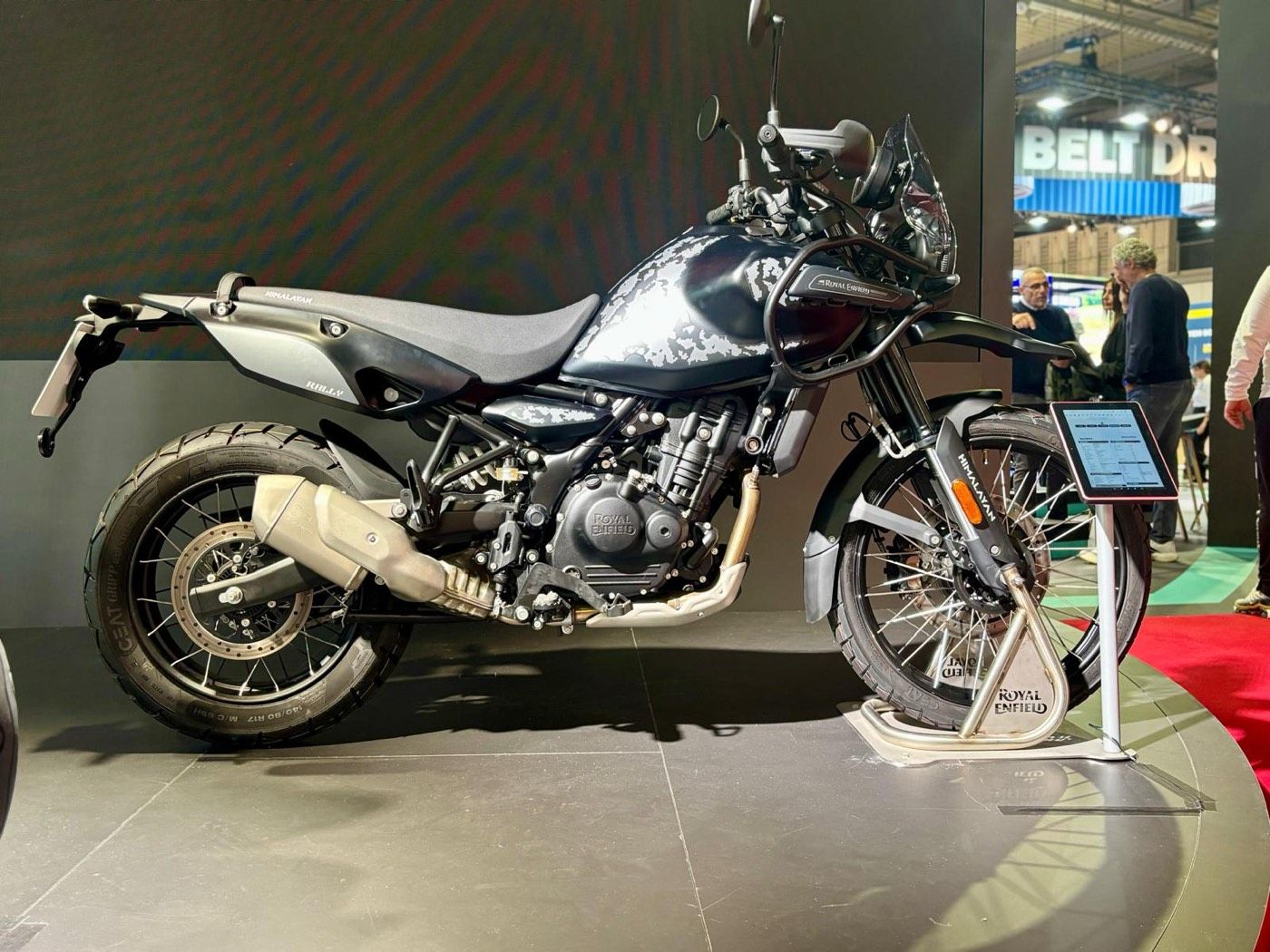
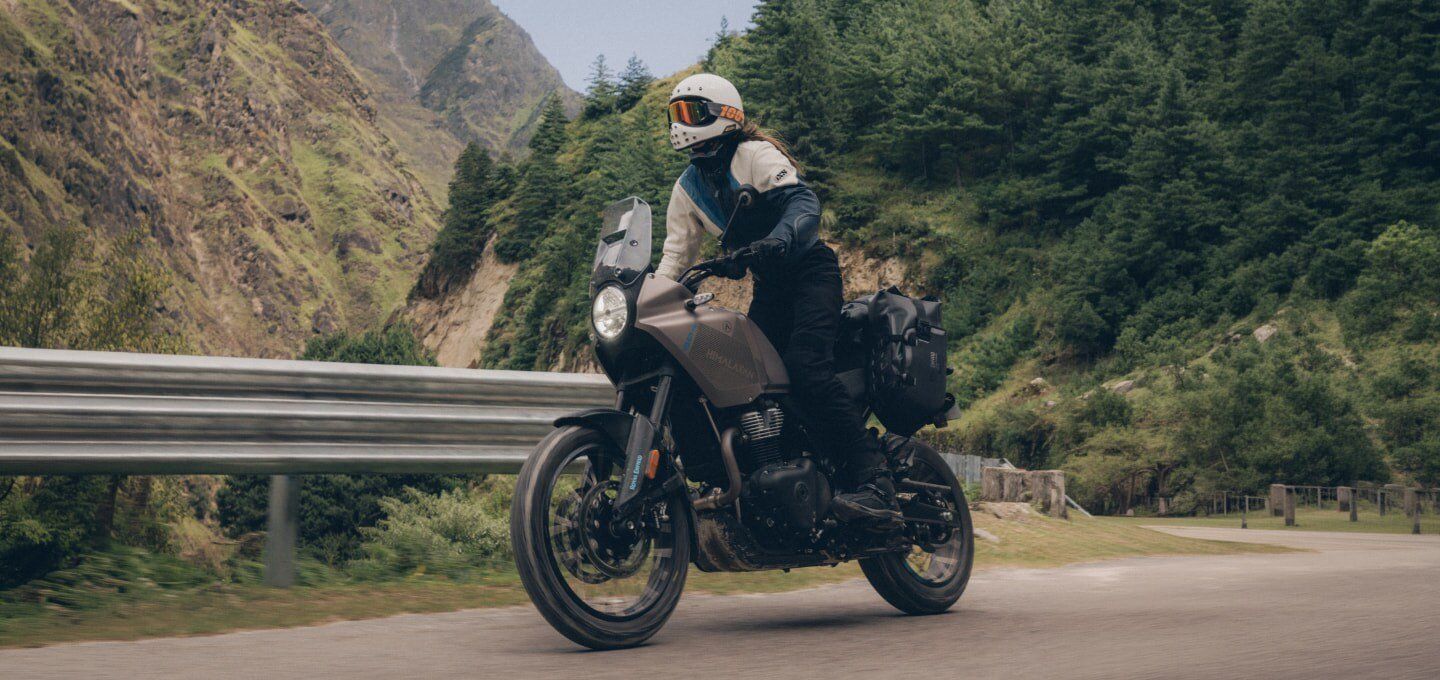
Royal Enfield has unveiled the Himalayan 750, the first twin-cylinder motorcycle to carry the Himalayan name. The reveal took place at EICMA in Milan, where the company published the complete specification rather than another round of hints: a 743cc air/oil-cooled parallel-twin making 55 PS and 63 Nm, fully adjustable Showa suspension at both ends, a six-axis IMU, cornering ABS, cruise control and a 4G-connected instrument display. Several of those items have not appeared together on a Royal Enfield before, and the specification is written around them rather than bolted onto a styling exercise.
What was not announced matters as much. There is no Indian price, no variant list, and no confirmed date on which dealers start taking orders. Royal Enfield India has the motorcycle live on its site with a full specification and an invitation to register interest, which is a long way from a launch. Two Indian publications report that the India announcement is expected around Motoverse, the brand’s annual rider event, which runs from 27 to 29 November 2026.
The other thing the unveiling settles is what this motorcycle is for. Royal Enfield’s own comparison table gives each Himalayan a one-line proposition: the 440 is accessible adventure riding, the 450 is all-terrain versatility, and the 750 is long-distance touring. Less travel than the 450, a smaller front wheel, a bigger tank and a twin-cylinder engine — that is a tourer, and the specification says so plainly.
What the Himalayan 750 is, and why it took this long
A 750cc Himalayan is not a new idea, and Royal Enfield spent years arguing against it. The company’s own account of the programme, given at the unveiling, is that when the 648cc parallel-twin arrived in 2017-18 the answer was no: the engine did not suit a Himalayan and the segment did not need one. Somewhere around 2021 that position softened into a question, several styling directions were drawn, and a prototype was assembled by putting Himalayan bodywork on the existing 650 twin to see whether the combination had any character at all. It evidently did, because the motorcycle shown in Milan is the result.
The 648cc platform is well known from the Interceptor 650 and its siblings, where Royal Enfield rates it at 47 PS (34.9 kW) and 52.3 Nm. The 750 moves that on in every useful direction — 95cc more capacity, 8 PS and 10.7 Nm more — while keeping the same basic architecture, the same oil-cooling philosophy and the same gearbox count. See also our note on how horsepower, bhp and PS differ, because the 55 PS figure is quoted in a unit that Indian brochures use loosely.
It is worth being clear about what this motorcycle is not. It does not replace the Himalayan 450, which remains on sale and which MotoSutra has reviewed at length. It sits above it, and the two are aimed at different riders — a distinction the hardware supports rather than one the marketing has to insist on.
Engine: 743cc of reworked 650
The published figures are the interesting part, because an air/oil-cooled twin with these numbers is a deliberate departure from what the segment is doing. Maximum output is 55 PS (40.5 kW) at 7,000 rpm and 63 Nm at 5,000 rpm, from a bore and stroke of 83.5 mm by 67.8 mm at a 9.5:1 compression ratio. Royal Enfield claims 90 percent of that torque is available from 3,500 rpm, which is the number a tourer actually lives on; the peak is a brochure figure, the plateau is the usable one. Idle is set at 1,300 rpm, lubrication is a wet sump running fully synthetic 10W-50, and the gearbox has six speeds.
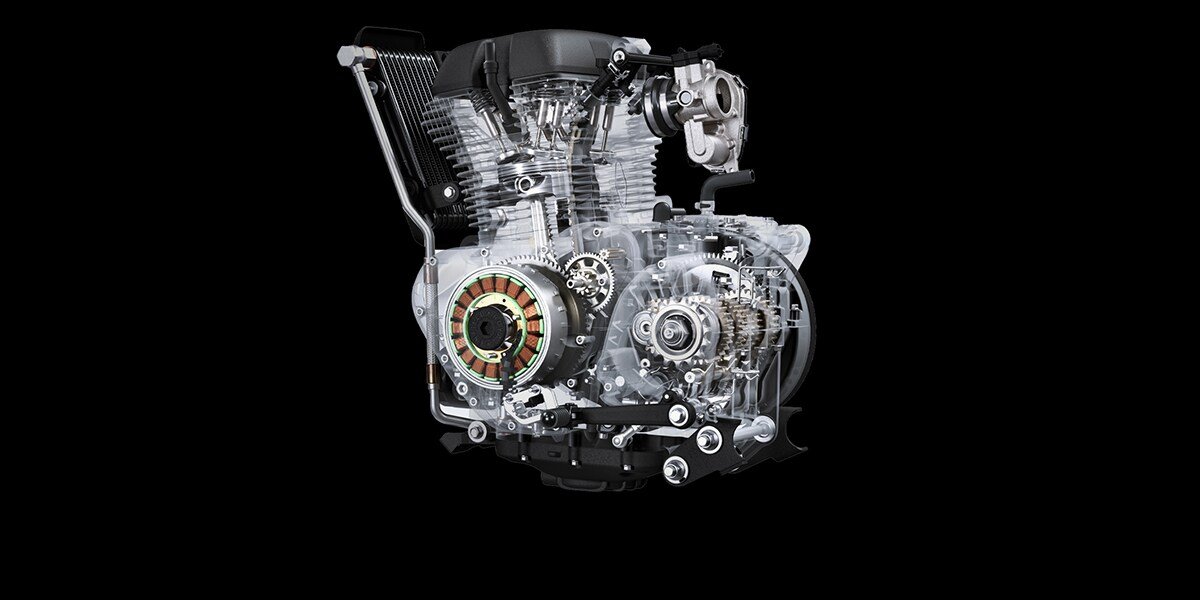
At the unveiling the company described roughly 90 percent of the engine’s components as changed, and that claim is worth unpicking rather than repeating. What is confirmed is the geometry: the 750 runs an 83.5mm bore against the 650’s smaller one, and Royal Enfield says the stroke was carried over while the bore was enlarged. What was described at the event, and is not visible in the published specification, is the rest — a magnesium crankcase, a single intake bore that splits to serve both cylinders, revised cooling, thinner external cooling fins, and a redesigned alternator to carry the additional electrical load. The exhaust is a new two-into-one, slimmer than the 650’s, and the company’s position is that the block weighs about the same as the 650’s despite being larger.
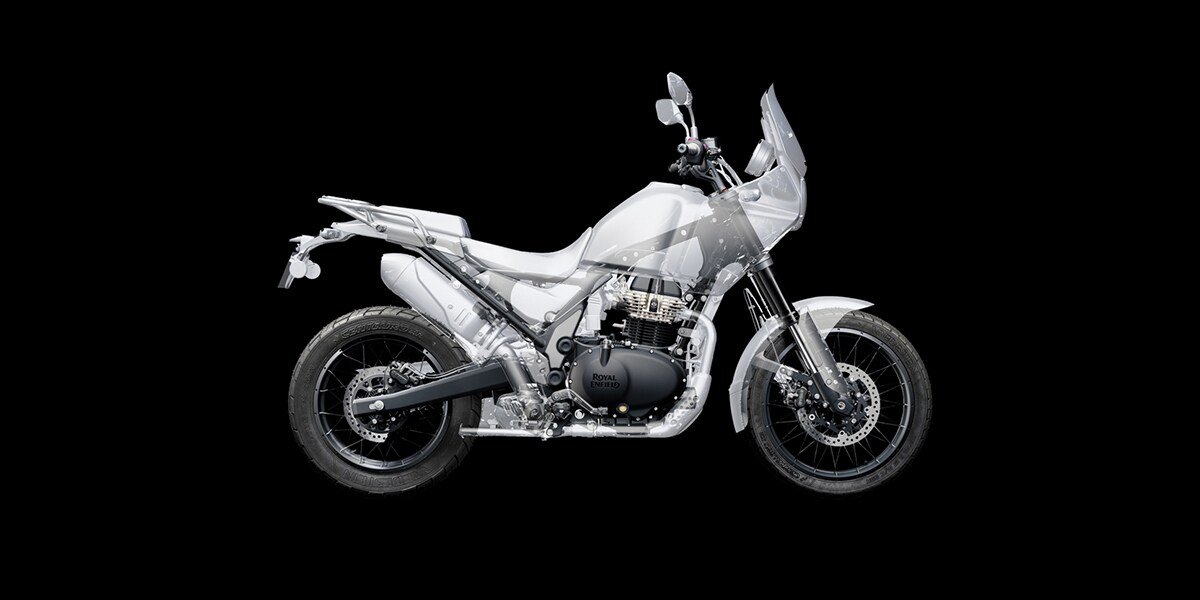
The engine is also structural. Royal Enfield’s specification calls the frame a box-section spine with pressed steel outriggers and the engine a stressed member, which is why the unit has to be built around the chassis rather than dropped into it.
Two omissions are worth recording. There is no quickshifter in the published feature list, and the motorcycle shown at the unveiling did not have one. And the India specification describes the clutch only as a wet multi-plate unit; a slip-and-assist function was mentioned during the unveiling but does not appear in the table on Royal Enfield’s own page, so it should be treated as reported rather than confirmed.
Design, wheels and hardware
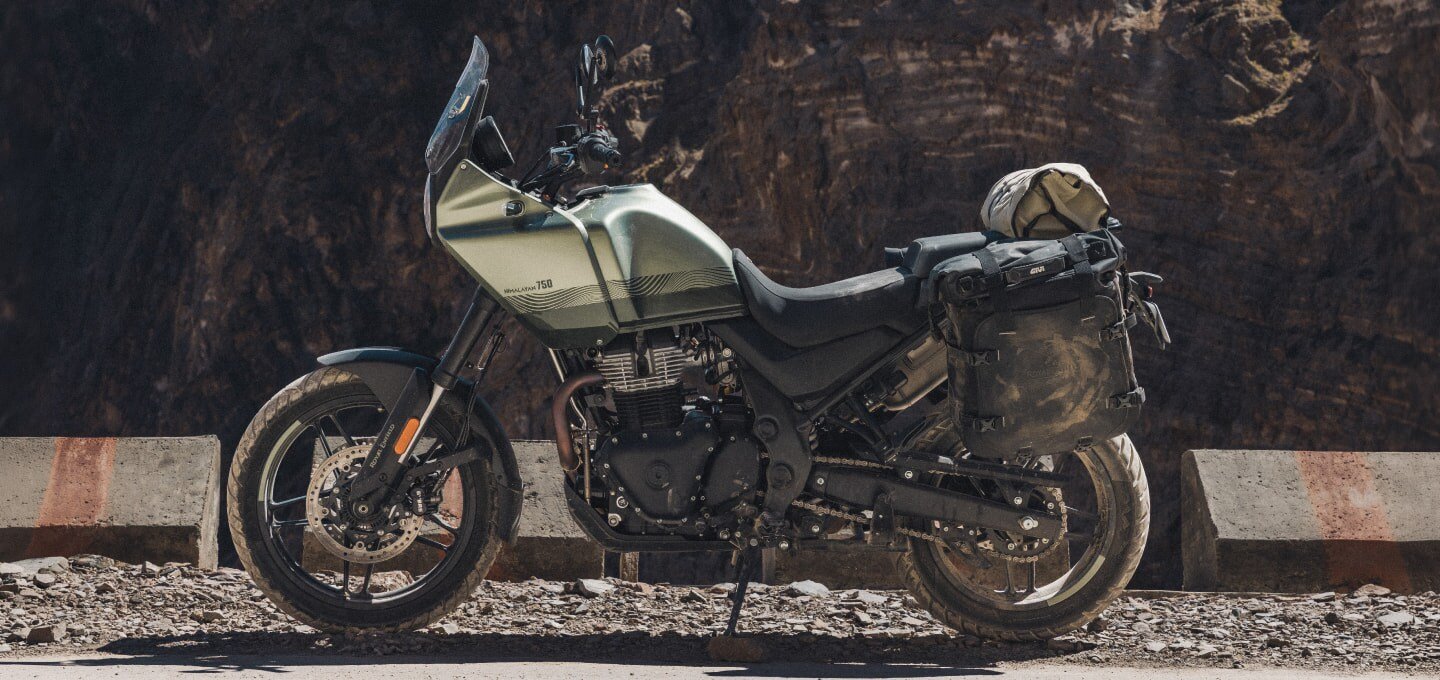
The styling reads as an enlarged Himalayan rather than a separate design study: a tall beak and flyscreen, a round headlamp, a stepped seat, an exposed twin and a black frame, with the exhaust swept up on the right. The tank is metal and holds 17.8 litres, which is the single specification that most directly explains what this motorcycle is for.
Wheels are 19 inches at the front and 17 at the rear, tubeless on both, with 110/80 R19 and 150/70 R17 tyres. Buyers get a genuine choice of hardware rather than a trim-level afterthought: cast alloys on the Aztec Green and Tectonic Black colourways, spoked wheels on Antarctic Silver, Siberia White and Viking Bronze. The tyres differ by wheel type as well — CEAT Crossrad AT on the alloys, Vredestein Centauro XR on the spokes. Five colours in total, with Antarctic Silver positioned as the range-topper.
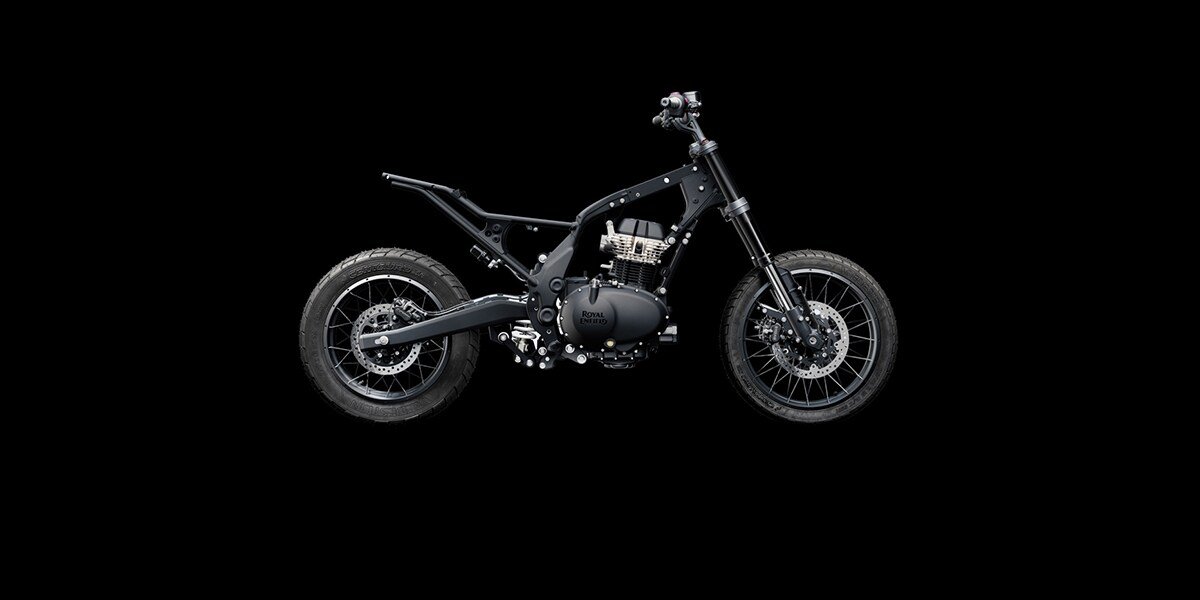
Weight is the number that needs watching. Kerb weight is published at 224 kg with 90 percent of fuel and oil on board, and payload capacity at 194 kg. That is 28 kg more than the Himalayan 450 and a good deal more than the single-cylinder middleweight adventurers this will be shortlisted against. Royal Enfield says it spent the extra capacity elsewhere — aluminium in the mirrors and other components, high-tensile steel elsewhere in the frame — but the motorcycle is still heavier than the bike it sits above. Whether that matters on the road is a question for a road test, not a spec sheet.
Neither the variant line-up nor the price gap between spoked and cast wheels has been announced.
Suspension and braking
Front suspension is a 43mm Showa upside-down fork of cartridge type, adjustable for preload, compression and rebound, with 190mm of travel. At the rear, a Showa monoshock with linkage offers 175mm and adjusts for rebound, with preload set from a remote dial at the shock — the kind of control that earns its keep the moment a pillion and luggage go on board.
That travel figure is the most telling number on the sheet, because it goes down rather than up. The Himalayan 450 runs 200mm at both ends and 230mm of ground clearance; the 750 has 190mm and 175mm with 205mm of clearance, on a 19-inch front wheel instead of a 21-inch one. Royal Enfield has built a tourer that can handle rough tracks, not a bike that wants them. Fully adjustable, load-adjustable suspension is the right answer to that brief; long-travel geometry would not have been.
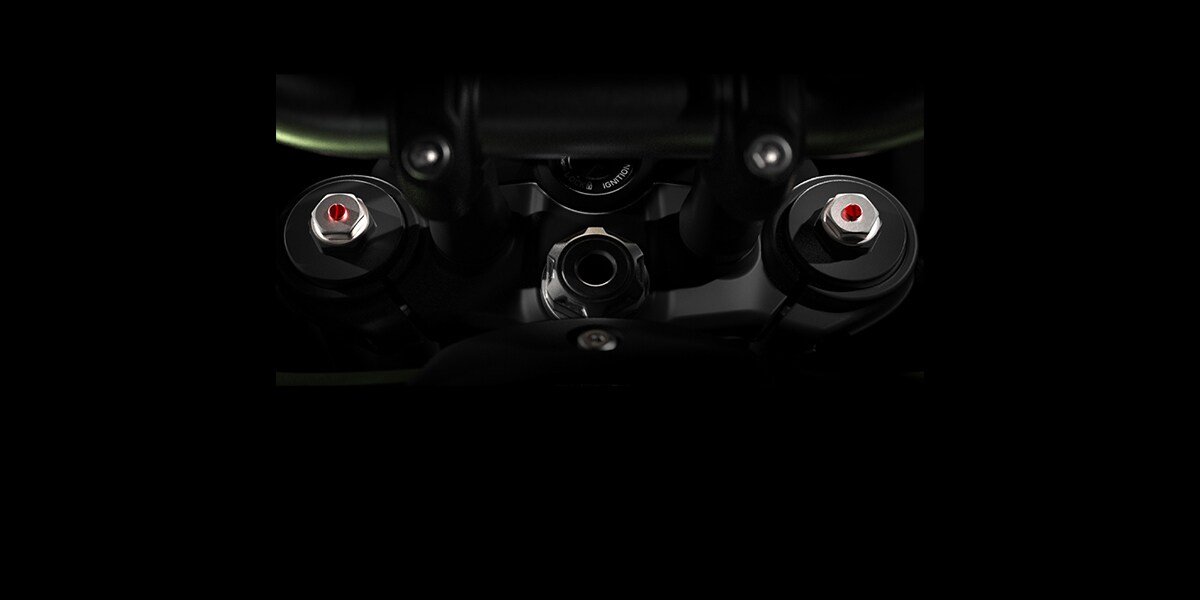
Braking is twin 280mm floating discs at the front and a 255mm disc at the rear, worked by two-piston floating calipers on both ends. Royal Enfield’s India page does not name the caliper supplier; ByBre was mentioned during the unveiling. ABS is dual-channel with the rear channel switchable off, and cornering ABS appears in the specification as standard equipment rather than as part of an optional package.
Technology and equipment
The headlamp is a new 7-inch round LED unit, and the detail that makes it interesting is an adjustable beam throw, operated by a knob at the front of the lamp. The reason is specific to this kind of motorcycle: with 190mm and 175mm of suspension travel, and a bike that spends its life carrying luggage and a passenger, the attitude changes constantly, and a low beam aimed for an unloaded machine will blind oncoming traffic or light the wrong part of the road. Royal Enfield says the lamp’s overall output is improved, partly through new reflectors.
The screen adjusts through five positions and 60mm of movement, and additional side deflectors were shown as an option.
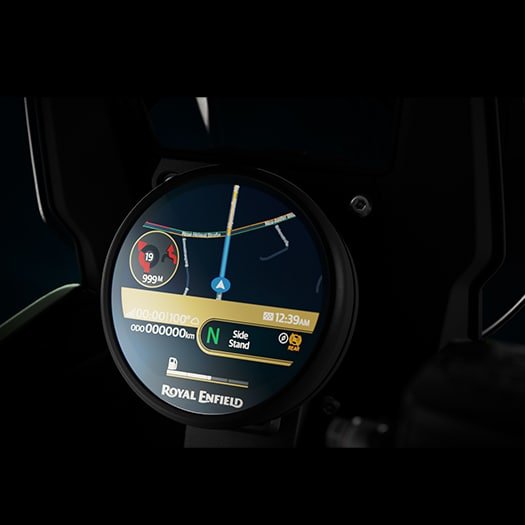
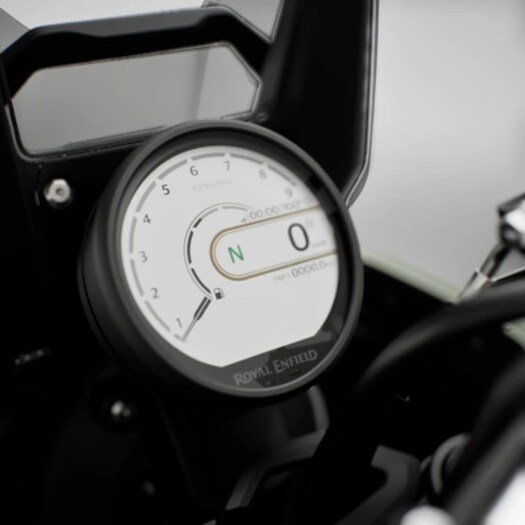
Instrumentation is the familiar 4-inch round TFT, here running full-screen Google Maps navigation with phone and music control over Bluetooth and Wi-Fi. Royal Enfield’s specification lists the connectivity system as Wingman 2.0 with 4G and GPS, which means a SIM-linked motorcycle rather than a phone acting as a modem; during the unveiling the platform was described as running on a Snapdragon processor handling bike-to-cloud traffic, and the companion app arrives with the launch. Charging is unusually generous: two USB Type-C ports, one rated 27W and a second 10W tucked under the seat.
The rest of the published list is TPMS as standard, self-cancelling indicators, an emergency brake light and an immobiliser. Two points of housekeeping on the evidence: Royal Enfield’s own table marks TPMS as standard equipment, whereas the GIVI luggage set, heated grips, hand guards and aluminium skid plate belong to an optional tour pack on the flagship colour. And the pressure sensors are described during the unveiling as real transducers reporting to the display, not an ABS-based inference — a distinction worth making, because the cheaper method is common on this class of motorcycle.
Riding modes and rider aids
Five modes: Road, Road Sport, Rain, Trail and Custom. The operating logic is more useful than the names, because it tells you which ones you are meant to use. Road, Road Sport and Rain can be selected while riding, with the throttle shut; Trail and Custom require the motorcycle to be stopped. That split is deliberate — the two modes behind the stop are the ones that change what the safety systems do, not just how the engine responds.
Underneath sit two throttle maps, four traction-control settings (Low, Medium, High and Off) and three ABS behaviours. Road holds ABS at its normal sensitivity, Rain raises it, and Trail switches the rear channel off entirely. The front channel never switches off, but was described at the unveiling as re-mapped for loose surfaces rather than left at its road calibration. Changing any of this away from a mode’s default produces a warning on the display, which is the correct way to handle a rider who has just disabled a safety system without meaning to.
A six-axis IMU — three accelerometers and three gyroscopes — provides the lean angle that cornering ABS and lean-sensitive traction control run on, and Royal Enfield also lists lean-sensitive cruise control, which is the more unusual of the two: conventional cruise control holding a set speed through a long, damp Bikaner curve is exactly the situation riders worry about. Cruise control itself was described at the unveiling as a first for a Royal Enfield production motorcycle, a claim the company has not repeated in the published specification. Custom is the persistent profile, holding the rider’s own combination of throttle map, traction-control level and ABS behaviour.
The practical reading is in Royal Enfield’s own comparison table, which lists the 450’s rider aids as ride modes and the 750’s as ride modes, cruise control and lean-sensitive cruise control. A rider can set throttle response, traction-control intervention and ABS behaviour independently here in a way the single-cylinder Himalayan does not offer. How well the calibration holds up on Indian surfaces is a different question, and one that cannot be answered from a launch.
Comfort, ergonomics and touring
Seat height is 815mm as standard. Two accessory seats were shown: a lower one at 795mm and a touring seat at 835mm, both available at launch, which is a more useful spread than a single fixed height. The motorcycle shown in Milan was fitted with the 20mm-lower seat.
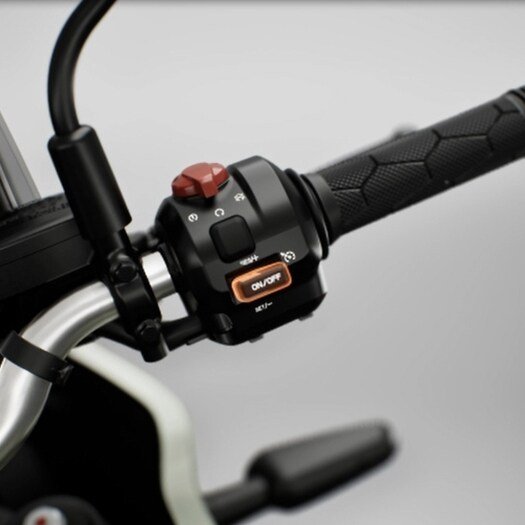
The controls were revised with the same intent. Mirrors are aluminium, the clutch lever adjusts, and the four-way joystick with its centre press was redesigned to sit flatter and less glossy than the unit on the Himalayan 450, which drew criticism from riders of that bike. A dedicated mode button cycles the ride modes and a long press swaps the display between its analogue and digital presentations; there is a separate ABS button on the right-hand cluster.
Touring provision is where the 750 makes its case. Payload is 194 kg, and the rear rack is rated at 7 kg during the unveiling — enough for a top box and not much more, which is why the luggage story is about the pannier set rather than the seat. Under the saddle there is a small storage pocket and the second USB-C port. Royal Enfield developed its accessories range with GIVI during the programme, and the flagship Antarctic Silver can be specified with a tour pack comprising a GIVI top box, panniers, mounts and inner bags, plus heated grips, hand guards and an aluminium skid plate. Protection accessories, including an engine guard, are on the same list.
One detail from the Milan motorcycle will not carry to India: the arrow-style exhaust shown as an option is for European markets, and India-specification motorcycles will carry a mudguard that the European bikes do not.
Mileage, fuel tank and expected range
There is no certified economy figure for the Himalayan 750. Royal Enfield publishes none on its India page, and dealer-facing listings mark mileage as still to be tested. The number in circulation comes from coverage of the unveiling, where an approximation of roughly 20 km/l was offered. That is an estimate from a company presentation, not an ARAI certificate or a road test, and it should stay labelled that way.
The arithmetic on that estimate is still worth doing, because it shows what the tank is for. At 20 km/l, the 17.8-litre capacity suggests a theoretical maximum of around 350 km before the reserve. At a more conservative 15 km/l — what a loaded bike on an Indian highway is likely to return — the figure falls to roughly 265 km. Either way the useful range is comfortably beyond what the Himalayan 450’s 17-litre tank can offer on the same consumption, and the point of the extra capacity is fewer stops on a long day rather than a headline number.
One caveat for Indian buyers: the motorcycle shown in Milan carries E5/E10 fuel labelling. Royal Enfield has not published the fuel rating for the India specification, and E20 compatibility is worth confirming from the launch material rather than assuming from the European bike.
Himalayan 750 price and India launch
No Indian price was announced at EICMA, and nothing in Royal Enfield’s India material implies one is imminent. The model page carries a specification, five colours and a register-your-interest form; the price field is empty. What did come with the unveiling is the European launch: bookings are open across Europe, and UK pricing runs from £6,999 for the cast-alloy motorcycle, £7,299 for the spoked version, and £8,699 for the Antarctic Silver tour pack model with the GIVI luggage, heated grips, hand guards and skid plate fitted.
Those numbers are worth reading as market context, not as a forecast. Royal Enfield’s UK prices include taxes and duties that an ex-showroom Indian price does not, and the company’s own history — the 450 launched here at a price well below what the same motorcycle costs in most European markets — means a rupee conversion of the UK figure would be misleading. What can be said is that the 750 is the largest-displacement Royal Enfield yet unveiled, above the 648cc twins the company currently sells in India, that variant-wise pricing has not been disclosed, and that two Indian publications covering the reveal point at Motoverse — the brand’s annual rider event, scheduled for 27-29 November 2026 — as the likely moment the India numbers arrive.
Himalayan 750 specifications
| Specification | Royal Enfield Himalayan 750 |
|---|---|
| Engine | 743cc air/oil-cooled SOHC parallel-twin, 4-stroke |
| Bore × stroke | 83.5 mm × 67.8 mm |
| Compression | 9.5:1 |
| Max power | 55 PS (40.5 kW) @ 7,000 rpm |
| Max torque | 63 Nm @ 5,000 rpm |
| Gearbox | 6-speed |
| Clutch | Wet multi-plate |
| Frame | Box-section spine, engine as stressed member |
| Front suspension | Showa 43mm USD, preload/compression/rebound adjustable, 190mm travel |
| Rear suspension | Showa linkage monoshock, rebound adjustable, remote preload, 175mm travel |
| Front brake | Twin 280mm floating discs, 2-piston floating calipers |
| Rear brake | 255mm disc, 2-piston floating caliper |
| ABS | Dual-channel, rear switchable; cornering ABS standard |
| Wheels | 19-inch front, 17-inch rear; cast alloy or spoked, tubeless |
| Tyres | 110/80 R19 front, 150/70 R17 rear |
| Fuel tank | 17.8 litres |
| Kerb weight | 224 kg (with 90% fuel and oil) |
| Payload | 194 kg |
| Seat height | 815 mm (795 mm low and 835 mm touring seats as accessories) |
| Ground clearance | 205 mm |
| Wheelbase | 1,522 mm |
| Dimensions (L × W × H) | 2,185 × 840 × 1,450 mm |
| Display | 4-inch round TFT, Google Maps navigation, Wingman 2.0 (4G/GPS) |
| Charging | Dual USB Type-C (27W + 10W) |
| Rider aids | Five ride modes, two throttle maps, cruise control, lean-sensitive traction control, TPMS |
| Colours | Antarctic Silver, Aztec Green, Siberia White, Tectonic Black, Viking Bronze |
| India price | Not announced |
Mileage, warranty, service intervals, variant names and India ex-showroom pricing are not part of the published specification and are left blank rather than filled in from another market’s numbers.
Himalayan 750 vs Himalayan 450
| Area | Himalayan 750 | Himalayan 450 |
|---|---|---|
| Engine | 743cc air/oil-cooled parallel-twin | 452cc liquid-cooled single-cylinder |
| Max power | 55 PS @ 7,000 rpm | 40.02 PS @ 8,000 rpm |
| Max torque | 63 Nm @ 5,000 rpm | 40 Nm @ 5,500 rpm |
| Gearbox | 6-speed | 6-speed |
| Suspension travel (front/rear) | 190 mm / 175 mm | 200 mm / 200 mm |
| Wheels (front/rear) | 19-inch / 17-inch, alloy or spoke | 21-inch / 17-inch, spoke |
| Tyres (front/rear) | 110/80 R19 / 150/70 R17 | 90/90 R21 / 140/80 R17 |
| Brakes (front/rear) | Twin 280 mm / 255 mm | 320 mm / 270 mm |
| ABS | Dual-channel, cornering ABS, rear switchable | Dual-channel, rear switchable |
| Fuel tank | 17.8 litres | 17 litres |
| Kerb weight | 224 kg | 196 kg |
| Seat height | 815 mm | 825-845 mm |
| Ground clearance | 205 mm | 230 mm |
| Cruise control | Yes | No |
| Royal Enfield’s stated proposition | Long-distance touring | All-terrain versatility |
Every figure above is taken from Royal Enfield India’s own comparison table for the Himalayan range, which also lists a third model — the 443cc, air-cooled single-cylinder Himalayan 440, at 25.4 bhp, 34 Nm and 199 kg, positioned as the accessible entry to the range. The 450’s adjustable 825-845mm seat range and the 750’s fixed 815mm standard height are the company’s numbers, not measurements. Note that the 750 has less suspension travel, less ground clearance and a smaller front wheel than the 450 it sits above: this is a heavier, more powerful motorcycle aimed at roads rather than at the line the 450 was drawn to cross.
Our take: is the Himalayan 750 worth waiting for?
For riders who have wanted a twin-cylinder Himalayan, the argument is now concrete rather than aspirational. A parallel-twin with 63 Nm available from low revs is a fundamentally more relaxed machine for two-up highway touring than a stressed single, and the equipment list — 17.8 litres of tank, adjustable Showa suspension, 194 kg of payload, a proper tour pack — is written for exactly that use. Cruise control on a Royal Enfield would have sounded like a decade-old rumour when the company was still publishing two-valve 350s; here it is, with a lean-sensitive version alongside it.
The more substantial story is the electronics. A six-axis IMU with cornering ABS, four-level traction control, three ABS behaviours and a persistent custom mode is a package that Indian manufacturers have generally reserved for litre-class machines at three times the money. Royal Enfield has fitted it to an air/oil-cooled twin rather than a liquid-cooled flagship, which suggests the company believes the platform will carry the software cost at volume. Trail mode with the rear ABS switched off, on a bike with 175mm of rear travel and a 19-inch front wheel, also tells you honestly what the off-road ceiling is.
The counterweights are real. 224 kg kerb is heavy for a middleweight adventure tourer, the ground clearance is lower than the 450’s, and the price will do most of the deciding: how far above the 450 the 750 lands will determine whether buyers see a tourer worth the difference or an upsell. The segment it enters is also more crowded than the one the 450 had to itself.
Nobody outside Royal Enfield has ridden this motorcycle at the time of writing, and nothing above is a riding impression. Suspension calibration, gearbox feel, real-world economy and how the traction control behaves on wet tar are all open questions until an India-specification machine can be ridden properly and priced. What the unveiling establishes is that the hardware is there; whether the sum adds up is a job for a road test.
Frequently asked questions
What is the Royal Enfield Himalayan 750?
It is the larger adventure tourer built above the Himalayan 450, and the first Himalayan with two cylinders. Royal Enfield unveiled it at EICMA in Milan on 3 November 2026 and has published the full specification on its India site, although the motorcycle is not yet on sale in India.
What engine does the Himalayan 750 use?
A 743cc air/oil-cooled inline parallel-twin with a SOHC four-valve head, described by Royal Enfield as a development of its 648cc twin rather than a separate engine. Published figures are 55 PS (40.5 kW) at 7,000 rpm and 63 Nm at 5,000 rpm, through a 6-speed gearbox. Compression is 9.5:1 and bore and stroke are 83.5 mm by 67.8 mm.
Does the Himalayan 750 have cruise control and a quickshifter?
Cruise control is in Royal Enfield’s published specification, together with a lean-sensitive variant of it. A quickshifter is not: the feature list on the India model page does not include one, and the motorcycle shown at the unveiling did not carry one.
What is the Himalayan 750 mileage figure?
There is none to quote. Royal Enfield has not published a certified economy figure for the Himalayan 750, and the only number in circulation is an approximation of roughly 20 km/l offered during coverage of the unveiling. Treat it as an estimate.
When will the Himalayan 750 launch in India and what will it cost?
Royal Enfield has announced neither. India pricing and a launch date were left out of the EICMA reveal; two Indian publications report that the announcement is expected around Motoverse, the brand’s annual rider event, which runs from 27 to 29 November 2026. Prices are open in the United Kingdom, where the motorcycle starts at £6,999.
How is the Himalayan 750 different from the Himalayan 450?
The 450 is a liquid-cooled single-cylinder with 200 mm of suspension travel at both ends, a 21-inch front wheel and 230 mm of ground clearance. The 750 is an air/oil-cooled twin with 190 mm at the front and 175 mm at the rear, a 19-inch front wheel and 205 mm of ground clearance. Royal Enfield’s own comparison table describes the 450 as an all-terrain package and the 750 as a long-distance tourer.