Bike comparison
Bajaj Dominar 400 vs Royal Enfield Himalayan 450: two answers to the same highway
Forty brake horsepower apiece, ₹67,000 apart, and completely different ideas about what a big single is for. We put both theories against the same documented tarmac, gravel and traffic they were built for.
- Bajaj Dominar 400 ₹2.18 lakh
- Royal Enfield Himalayan 450 ₹2.85 lakh

Editor & Publisher
Head to head
- Price Bajaj Dominar 400 ₹2.18-2.33 lakh against ₹2.85-3.25 lakh ex-showroom Delhi NCR. Loaded for touring, the gap widens in the Bajaj’s favour.
- Torque and mid-range pull Royal Enfield Himalayan 450 40 Nm from 5,500 rpm against 35 Nm from 6,500 rpm, and the Enfield reaches its 40 bhp peak 800 rpm earlier.
- Highway pace and wind protection Bajaj Dominar 400 A 155 km/h ceiling against 145 km/h, plus a two-part screen with four positions of adjustment as standard.
- Off-road hardware Royal Enfield Himalayan 450 240 mm of travel at both ends, 230 mm of clearance and a 21-inch front wheel, against 170 mm of clearance on 17-inch cast wheels.
- Two-up comfort on tarmac Even The Bajaj’s wide flat seat and under-seat exhaust keep a pillion cool; the Enfield’s long-travel suspension keeps them un-shaken. Different problems solved.
- Electronics and instrumentation Royal Enfield Himalayan 450 A five-inch TFT with turn-by-turn navigation, riding modes and IMU-based cornering ABS on the higher variant, against a digital console with a gear indicator.
- Claimed efficiency Royal Enfield Himalayan 450 30 kmpl against 28 kmpl, and the Enfield’s 17-litre tank is sized for the distance it expects to cover.
- Ease in traffic and at a standstill Bajaj Dominar 400 Three kilograms separate them, but the Dominar’s 810 mm saddle against the Himalayan’s 825 mm is the difference between flat footing and tip-toeing at a signal.
| Specification | Bajaj Dominar 400 ₹2.18 lakh | Royal Enfield Himalayan 450 ₹2.85 lakh |
|---|---|---|
| Ex-showroom price | ₹2.18 lakh | ₹2.85 lakh |
| Engine | 373 cc | 452 cc |
| Power | 40 bhp | 40 bhp |
| Torque | 35 Nm | 40 Nm |
| Mileage | 28 kmpl | 30 kmpl |
| Top speed | 155 kmph | 145 kmph |
| Gearbox | Manual | Manual |
| Kerb weight | 193 kg | 196 kg |
| Safety | Dual-channel ABS and a 300 mm front disc; no official crash rating | Switchable ABS with an off-road mode, cornering ABS on the higher variant; no crash-test rating |
| Body type | Cruiser tourer | Adventure |
| Status | Available | Available |
| Categories won | Bajaj Dominar 400 wins 3 of 11 | Royal Enfield Himalayan 450 wins 3 of 11 |
Only specifications present in both records are listed. figures without a named source document are unverified motosutra catalogue estimates, not official specifications. confirm current numbers with the manufacturer.
Both of these motorcycles make the same promise on the same piece of paper: forty brake horsepower from one large cylinder, enough to carry two adults and their luggage at a genuine highway pace. The ₹67,000 that separates their entry prices is not a quality gap. It is a statement about what each company thinks you will be doing with that power, and the interesting part of this comparison is how consistently each one sticks to its own theory.
The engines, which are not the same tool
On the dyno sheet they look like siblings; the shape of the two torque curves says they are two different characters, and since MotoSutra has ridden neither bike, this section reads the documented engines rather than a test log.
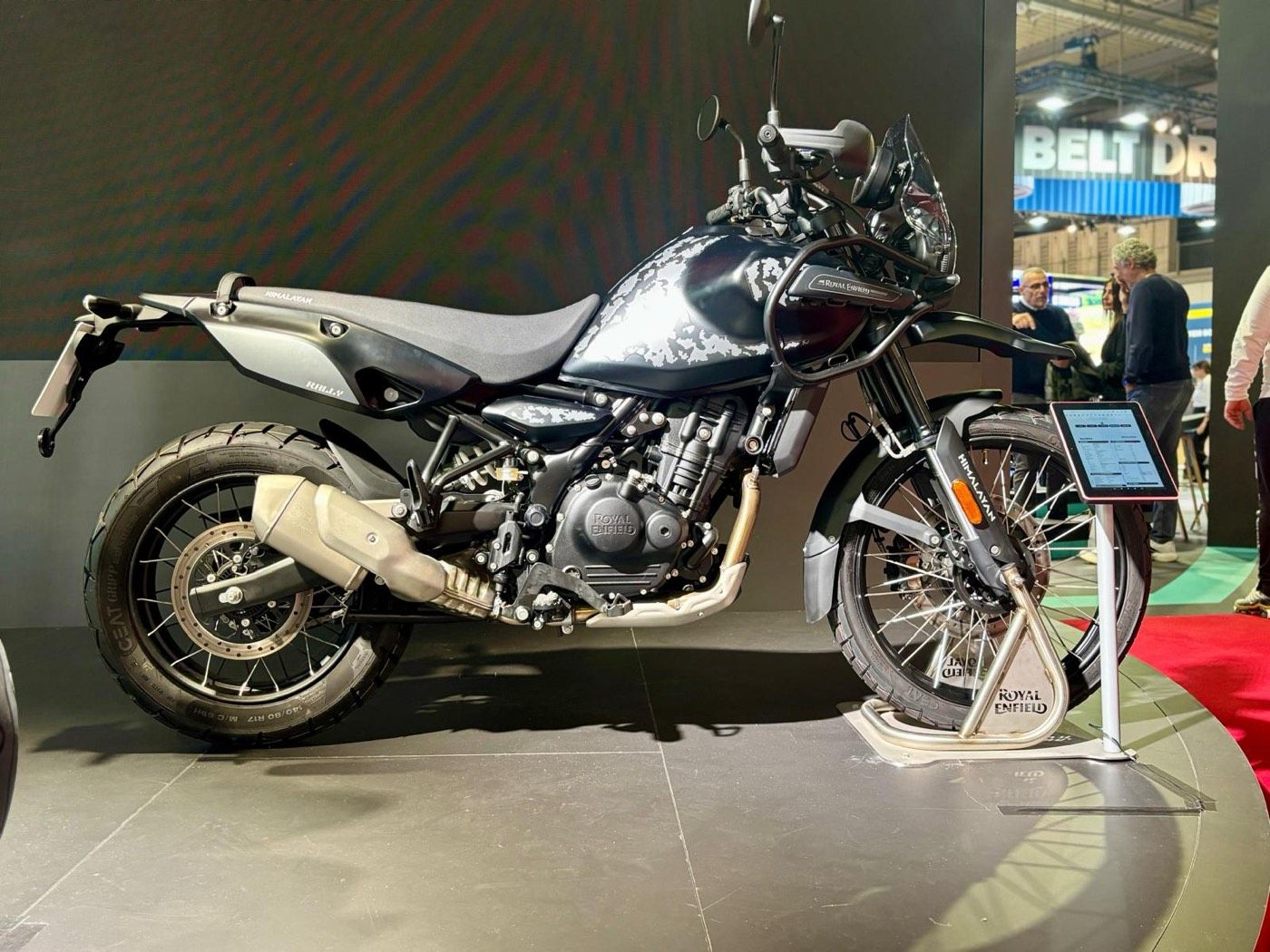
The Himalayan’s 452cc liquid-cooled single puts its 40 Nm down at 5,500 rpm and keeps pulling to a peak at 8,000, which means the rider can select a gear for a corner exit and trust the motorcycle to finish the job. The shape of that band rewards a high revs-in, late-braking style in a way no Royal Enfield has before, and the geometry — the 21-inch front wheel, the slim tyre section, the upright position — is that of a genuinely athletic machine; how keenly it actually turns in is a question only a test-ride can answer.
The Dominar’s 373cc unit is flatter and more blunt, in the good sense. Its 35 Nm arrives from just above idle and does not fall off much anywhere, so the six-speed gearbox exists mainly to reduce noise. The torque plateau is built for fifth and sixth at 60 to 100 km/h, for riding that rarely touches the clutch and simply arrives. It does not rev with the same eagerness and the peak lands 800 rpm later, but for the specific task of covering ground without asking anything of the rider, it is arguably the more appropriate engine of the two.
Wind is the other half of the highway argument. The Bajaj’s two-part screen adjusts through four positions and its under-seat exhaust keeps the heat away from the pillion, so at 110 km/h the Dominar is the quieter, cooler place to spend an hour by design. The Enfield pushes air at the rider, and its heat in slow, hot traffic is the drawback its own cons list names without being asked twice.
The Dominar is a motorcycle that has been to the shop and bought the touring equipment. The Himalayan is the touring equipment, fitted at the factory.
Where the Himalayan stops being a comparison
240 mm of suspension travel at both ends, 230 mm of ground clearance against the Bajaj’s 170 mm, a 21-inch front wheel on spoked rims shod in tubeless tyres, and ABS that can be switched into an off-road mode so the rear wheel is allowed to slide on gravel in a controlled way. The higher variant adds IMU-based cornering ABS, which is the sort of equipment that was reserved for far more expensive motorcycles until recently.
Put the same broken metaled road under both on paper and there is no contest. The Dominar is a 17-inch-wheeled tourer being asked to do something it was not designed for, and its wide 150-section rear tyre will hunt ruts on coarse tarmac exactly as you would predict. The Himalayan’s suspension numbers are what lets a heavy motorcycle feel like a light one, with enough travel that the rider can spend the day picking lines rather than enduring them. This is also where the extra money went. It was never hiding.
Two-up, and the everyday maths
For a pillion on tarmac the Bajaj is the easier sell: a low, flat dual panel, mirrors on the bar rather than the tank for a wider view, and heat routed away from the passenger’s legs. The Enfield counters with suspension that absorbs what the seat cannot, a hill hold for a loaded ramp start, and a taller saddle that gives the passenger a better view of whatever is causing the traffic.
In a city, weight is almost identical at 193 kg against 196 kg, so the difference comes down to height and width. The Dominar is undeniably broad but its 810 mm seat means most riders put both feet down, which is worth more at a long signal than any specification. The Himalayan’s 825 mm saddle is challenging below average rider height even with the lower seat option, and the servicing bill on a liquid-cooled engine with a six-axis IMU is the highest Royal Enfield asks of anyone in this line-up.
On claimed efficiency the Enfield wins on paper at 30 kmpl against 28, and its 17-litre tank is sized for the kind of crossings it is sold for. MotoSutra estimates real-world mixed-route figures at roughly 25-28 kmpl from the Himalayan and 23-26 from the Dominar, both with a passenger and both in heat, which is the sort of gap that pays for itself about once every two years.
Choosing
Buy the Dominar 400 if your riding is 90 per cent tarmac, if you carry a passenger, and if you would rather spend the difference in price on fuel, tyres and a second helmet. Buy the Himalayan 450 if there is a real chance you will turn onto a road that has no surface, because nothing else at this money is equipped for that day, and on the way there it is the more involving motorcycle to ride.
The two models
Frequently asked questions
Which of the two is better for long highway riding?
The Dominar 400, on tarmac. It is faster, it protects the rider better with an adjustable screen, its exhaust routes heat away from a passenger and it is cheaper to have serviced on a schedule you can predict.
Is the Himalayan 450 worth the extra money?
If you ride anywhere the surface changes, yes, and it is not close. The suspension, the ground clearance, the switchable ABS and the tubeless spoked wheels are a different category of equipment, and the engine is the more usable of the two below 6,000 rpm.
Which is the better first big motorcycle?
Neither is easy, but for different reasons. The Dominar has a low seat and abundant torque in a wide, heavy body that punishes a slow reaction. The Himalayan is taller, more forgiving at low speeds and asks for more upkeep.