Bike comparison
Classic 350 vs CB350 H'ness: the romantic and the engineer
Two 349cc singles, two philosophies, overlapping price tags within ₹2,000 of each other. Royal Enfield sells a story; Honda sells the better machine. We read both arguments against the documented hardware to see which survives ownership.
- Royal Enfield Classic 350 ₹1.93 lakh
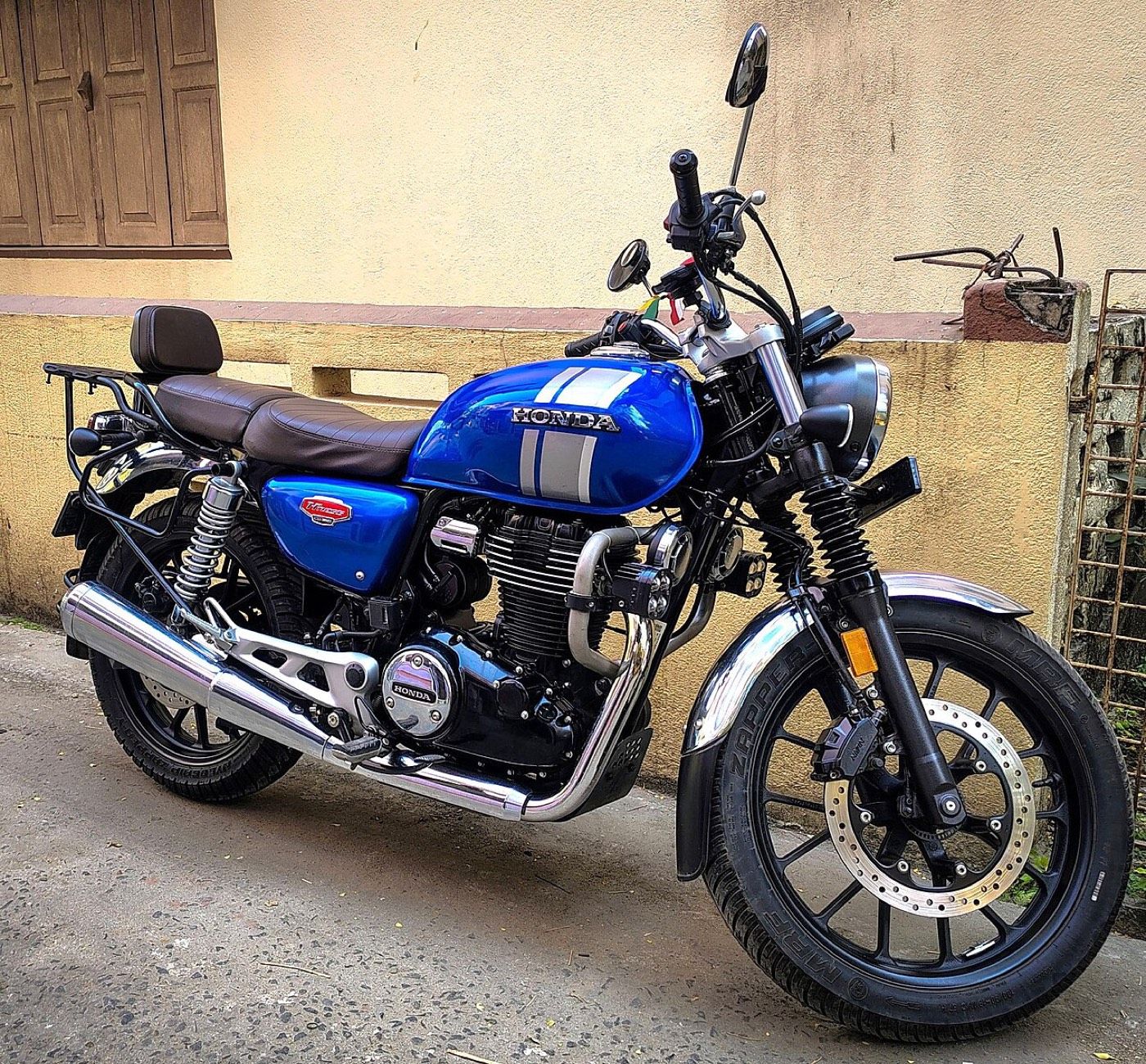
- Honda CB350 H’ness ₹1.95 lakh

Editor & Publisher
Head to head
- Price Royal Enfield Classic 350 ₹1.93 lakh buys the Classic’s entry Halcyon; the Honda starts at ₹1.95. At the top the order flips — ₹2.05 lakh for the Chrome against ₹2.02 for the H’ness Pro. The bands are a draw; the trims are not.
- Engine refinement Honda CB350 H’ness 20.8 bhp at 5,500 rpm and 27 Nm from 3,000 against 20.2 bhp at 6,100 and 27 Nm from 3,400 — and a gearbox and clutch this catalogue rates the best acting of the pair.
- Weight and agility Honda CB350 H’ness 181 kg against 195, with a narrower tank and bars. In a queue the Honda is the bike you can place anywhere; the Enfield is the one you steer around obstacles.
- Claimed mileage Honda CB350 H’ness 37 kmpl from a 13-litre tank against 36 from 13.5. MotoSutra estimates both land in the low-to-mid 30s in mixed use.
- Highway composure Royal Enfield Classic 350 A claimed 120 km/h against 115, and the mass that makes three digits feel settled rather than earned. The heavier Enfield irons out what the lighter Honda reports.
- Two-up comfort Royal Enfield Classic 350 Comfort scores 4.6 against 4.3 in this catalogue’s book: the Classic has the wider, flatter saddle, the roomier pillion arrangement and a backrest on the Chrome.
- Ownership case Royal Enfield Classic 350 Resale, service reach and accessory depth all sit with Royal Enfield; Honda’s two-wheeler network thins sharply outside the north-east and parts of the south, and it shows in used prices.
| Specification | Royal Enfield Classic 350 ₹1.93 lakh | Honda CB350 H’ness ₹1.95 lakh |
|---|---|---|
| Ex-showroom price | ₹1.93 lakh | ₹1.95 lakh |
| Engine | 349 cc | 349 cc |
| Power | 20.2 bhp | 20.8 bhp |
| Torque | 27 Nm | 27 Nm |
| Mileage | 36 kmpl | 37 kmpl |
| Top speed | 120 kmph | 115 kmph |
| Gearbox | Manual | Manual |
| Kerb weight | 195 kg | 181 kg |
| Safety | Dual-channel ABS standard on every variant; no official crash-test rating exists | Dual-channel ABS standard; Honda fit and finish, no official crash rating for the model |
| Body type | Cruiser | Cruiser |
| Status | Available | Available |
| Categories won | Royal Enfield Classic 350 wins 2 of 11 | Honda CB350 H’ness wins 3 of 11 |
Only specifications present in both records are listed. figures without a named source document are unverified motosutra catalogue estimates, not official specifications. confirm current numbers with the manufacturer.
Royal Enfield and Honda sell 349cc retro singles within a few thousand rupees of each other, and the two arguments could hardly be more different. One is selling the most recognisable motorcycle silhouette in India, refined across a decade into the default answer to “what should I buy at 350?” The other is selling the better engineering and knowing that the story is the one thing it cannot put on the spec sheet. MotoSutra has ridden neither bike, so what follows is a research-based reading of the documented hardware — where each argument actually leaves the purchase.
The numbers, which Honda wins
Open the catalogue and this comparison looks finished before it starts. The Honda’s 349cc single makes 20.8 bhp at 5,500 rpm against the Enfield’s 20.2 at 6,100, and its 27 Nm peaks at 3,000 rather than 3,400 — on paper the same torque, available earlier and with more revs left to spend. It claims 37 kmpl to the Classic’s 36, and it carries 181 kg to the Classic’s 195. Fourteen kilograms off a 349 single is not a rounding error; it is the difference between dropping the bike as a possibility and dropping it as an event.
The drivetrain detail is where the Honda’s money actually shows. The six-speed box is the best-shifting unit in this catalogue’s retro class, the clutch is light and correct, and the assist and slipper arrangement is designed to keep the rear polite under a downshift the Enfield’s gearbox can only report. The switchgear belongs to a more demanding market. The Classic is not bad at any of these things; the H’ness makes them a category.
In gentle city use the documented figures put both doing the same job. Where the sheets part is mass and geometry: at 14 kg lighter, with narrower bars and a slimmer tank, the Honda is the bike that should fit through the gap the Classic makes you look at — how willingly each is ridden into that gap is a question a test-ride answers faster than any spec sheet.
The things the numbers miss
The Classic’s 195 kg stops being a liability the moment the road opens, because mass is what steadies a motorcycle at a genuine 100 km/h: the longer wheelbase soaks up mid-corner ruts, the bars are the least twitchy kind, and the claimed 120 km/h ceiling is presented as a speed the bike arrives at without argument. The Honda’s claimed 115 is the harder ask of a lighter body whose suspension, on its specifications, reports highway expansion joints to the rider with more fidelity. MotoSutra states this from the engineering brief, not from a highway of its own; the trade is the same one the Hunter 350 comparison surfaced, and the physics says it is real.
Then the pillion. The Classic’s saddle is wider and flatter, the passenger has more room, a proper grab rail, and a backrest on the Chrome variant; this catalogue scores its comfort at 4.6 against the Honda’s 4.3, and MotoSutra puts the gap at one a regular pillion notices on the first long stop rather than the second. Buyers who carry a person more than twice a month are buying the Enfield whether they have read the spec sheet or not.
The third thing the numbers miss is the dealer network, and it is not sentimental. Royal Enfield’s reach, spares and accessory catalogue are a class ahead of Honda’s two-wheeler operation, which thins out sharply outside the north-east and parts of the south. That reach becomes resale: the Classic is the most liquid leisure motorcycle in the country, and the H’ness’s used numbers trail it despite being, on this evidence, the better new motorcycle.
Trim, and what ₹2,000 buys
The price bands cross: the Classic runs ₹1.93-2.05 lakh, the Honda ₹1.95-2.02. At the bottom the Enfield is marginally cheaper; at the top the Pro Honda, with discs at both ends, is cheaper than the Chrome Classic while the Enfield buys chrome mudguards and a backrest. Lighting is the visible split — full LED around the Honda, a halogen beam on the Classic that does not throw far enough on an unlit highway — and the H’ness carries a remote-guided seat unlock the Enfield has never offered. Ground clearance reads 165 mm for the Honda against the Classic’s 135, which matters more on Indian road surfaces than either brochure suggests.
The Classic’s defence is that none of this is what it is for. The paint, the chrome and the headlamp casing are the product, and buyers in this segment have always paid for the object as much as the machine.
Where it lands
Buy the CB350 H’ness if you ride mostly alone, mostly in a city, and you want the better engine, the better gearbox, 14 fewer kilograms and the better mileage for money that is, in this listing, effectively identical.
Buy the Classic 350 if a passenger rides with you, if your highways are long and coarse, if you keep motorcycles for years and care what one returns, or — honestly, and this is most of it — if you want the one that looks like the idea of itself.
Both are good answers. One is the better motorcycle and the other is the better purchase for how India actually keeps a motorcycle, and the spec sheets do not resolve which of those sentences belongs to which bike. That is your life to work out.
The two models
Frequently asked questions
Which is the better 349cc engine, the Classic’s or the CB350’s?
The Honda’s, on this catalogue’s figures: 20.8 bhp against 20.2, peak torque at 3,000 rpm rather than 3,400, and a claimed 37 kmpl against 36. The Enfield’s counter is character — the 180-degree-crank single sounds like nothing else at this capacity.
Is the CB350 H’ness worth the ₹2,000 premium over a Classic?
At entry, the Classic is actually ₹2,000 cheaper, and the Pro Honda is ₹3,000 cheaper than the Chrome Enfield. The money is effectively level; what you are choosing between is refinement against resale, and pillion comfort against 14 kg.
Which holds value better?
The Classic, clearly. It is the most liquid leisure motorcycle in the country and the used market prices that in. The H’ness is the better new purchase for many riders and the weaker three-year-old one.
I carry a passenger regularly. Does that decide it?
It decides a large part of it. The Classic’s wider, flatter seat and roomier pillion arrangement are worth the mass penalty on this catalogue’s scoring, 4.6 for comfort against 4.3. The Honda is a better solo machine.