Specs & analysis
Triumph Street Triple R 2020 review: what the India sheet says
The recovered Street Triple R page, rebuilt on Triumph India’s 2020 launch specification: what the document states, what it omits, and what was removed.
- Triumph Street Triple R ₹8.84 lakh

Editor & Publisher
MotoSutra editorial rating
4.2/5
Overall score across 6 rated dimensions
MotoSutra editorial rating: 4.2 out of 5
Lowest rated
Comfort
3.3/5
Ride quality & long-distance comfort
- Performance Power, acceleration & riding dynamics 4.7/5 Excellent
- Features Equipment & rider features 4.2/5 Very strong
- Design Styling, ergonomics & presence 4.2/5 Very strong
- Safety Build quality, safety equipment & ratings 4.1/5 Very strong
- Interior Rider ergonomics, seat & practicality 3.5/5 Good
- Comfort Ride quality & long-distance comfort 3.3/5 Average
This page was rebuilt on a different footing rather than rewritten. Where it previously carried invented numbers for a motorcycle Triumph India had never specified, it now carries the specification table from the manufacturer’s own launch release of 11 August 2020 — 118 PS at 12,000 rpm, 79 Nm at 9,350 rpm, Showa separate-function forks, Brembo M4.32 calipers and a standard quickshifter — and nothing that document does not state. Read it as the middle 765 as India was told to expect it: expensive hardware at the front wheel, an LCD display instead of the one you might assume, and a price of ₹8.84 lakh on the day it launched rather than today.
MotoSutra editorial rating on a 5-point scale. Rated across 6 dimensions; unscored dimensions are omitted.
What this page is, and what it was
This URL carried a Street Triple R review on an earlier MotoSutra deployment. That text is not in this codebase, and the page recovered in its place in the previous phase was written against catalogue figures that had been invented to look plausible. Phase 4C compared those figures with what Triumph Motorcycles India actually published for the 2020 model year, and the record behind this page now carries the manufacturer’s numbers, or nothing.
Three things follow. The figures below come from the specification table in the launch release Triumph India issued on 11 August 2020, a document that states its specifications are as per the ARAI certificate — so they are the India, BS-VI figures, not the Euro 5 numbers from Triumph’s global media pages. Fields that table does not state are absent from the listing rather than estimated; the spec table here has no kerb weight, no top speed and no colour strip, and that absence is the finding. And MotoSutra holds no test data of any kind for this motorcycle: no braking distances, no lap times, no dyno sheets and no owner panel, so the score above is an editorial grade of the specification and the listing, not a measurement.
The score’s methodology is worth stating because it is the only number on the page that is not transcribed. It grades how coherent and how well-equipped the documented specification is relative to its class and price, and its sub-scores are weighted toward hardware a rider can use. It is not an average of opinions, and it is not a substitute for riding the machine.
What Triumph India specified
The engine is a 765cc liquid-cooled in-line three, twelve valves, double overhead camshafts, listed at 86.8 kW — 118 PS — at 12,000 rpm and 79 Nm at 9,350 rpm in the India table. The distance between the two peaks is 2,650 rpm, and both sit in the top half of the rev range: this is an engine that has to be revved to be used at all, and the table publishes one torque figure rather than a plateau to fall back on. The horsepower explainer covers what a peak figure that late in the rev range tells a buyer and what it does not.
The rest of the specification is built to support that character rather than to soften it. The gearbox is a six-speed with Triumph Shift Assist — an up-and-down quickshifter — fitted as standard, and the clutch is a wet multi-plate unit with slip assistance, which is the component that makes an aggressive downshift a smooth event instead of a rear-wheel negotiation. Throttle control is ride-by-wire, and three riding modes — Road, Rain and Sport — change the throttle map and the traction-control intervention from the LCD instruments. In Rain, peak power is restricted to 100 PS: the mode designed for the worst surface gives up 18 PS of the headline figure, which is the honest way to read a power limit.
Where the money is, on the document
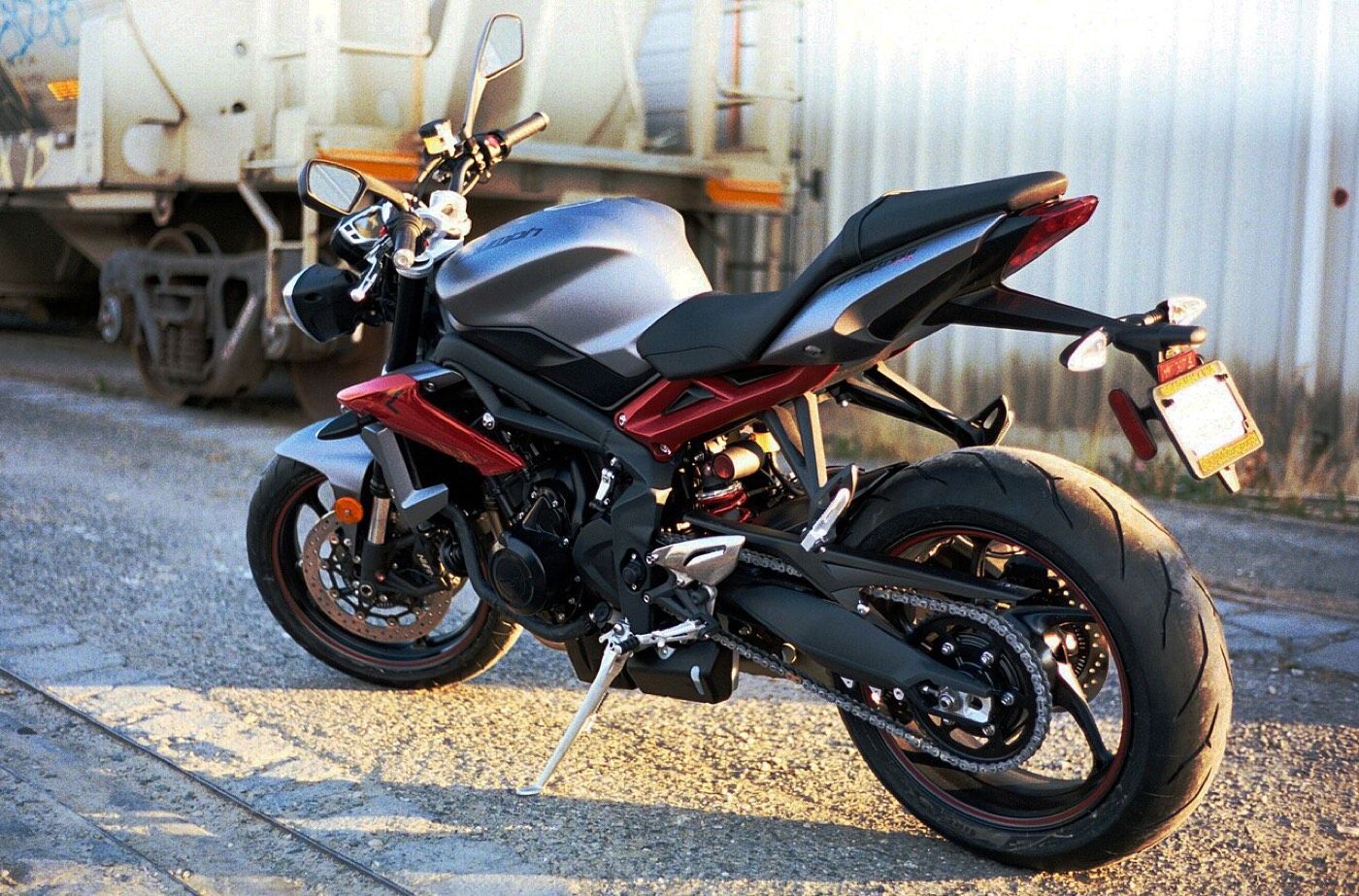
Read as a parts list, the India specification spends on the contact patches. The front suspension is a Showa 41 mm upside-down separate-function big-piston fork and the rear is a Showa piggyback reservoir monoshock, both listed as adjustable for preload, compression and rebound. The front brakes are twin 310 mm floating discs with Brembo M4.32 four-piston radial monobloc calipers; behind, a 220 mm disc with a Brembo single-piston caliper, with ABS on both ends. That is the configuration this trim exists to sell, and it is worth being precise about what such hardware contributes: not more grip in an emergency, where ABS arbitrates, but resolution in the first centimetres of lever travel and resistance to dive while the front end is loaded. The ABS explainer covers where that system takes over and where the caliper does not.
The structure around it is an aluminium beam twin-spar front frame with a two-piece high-pressure die-cast rear section, a twin-sided cast aluminium swingarm, cast alloy wheels on 120/70 and 180/55 ZR17 Pirelli Diablo Rosso III tyres, and an 825 mm seat height at a 1,405 mm wheelbase. Overall length is listed at 2,055 mm, width across the handlebars at 775 mm, and the tank holds 17.4 litres with a dry weight of 168 kg.
What the document does not say
The omissions are as informative as the figures, because they are where this page previously went wrong. There is no kerb weight in the India table — only the 168 kg dry figure — so the earlier 189 kg claim has been deleted, and no basis for it appears in the India document or in Triumph’s global material for the same model year. There is no top speed, which is why the row is gone: a manufacturer that publishes a power figure to three significant figures and no maximum speed is not hiding one so much as declining to claim it. There is no colour list, so the swatch strip stays empty; Triumph’s global material for the same model year names two paint schemes for a different market, and MotoSutra does not publish another market’s colours as an India listing.
The instrument display is the other correction, and it is the kind of detail a spec sheet gets wrong by association. The launch release describes the Street Triple R’s LCD instruments. The full-colour TFT display belongs to the range-topping trim in the same generation, and a page that borrowed it for the R was describing a motorcycle Triumph did not sell in India at that price.
Where it sits, and what it costs
The price on this listing is ₹8,84,000, the figure in the heading of the same launch release, and it is a launch price with its date attached rather than a quotation. Anyone reading it in later years should treat it as one point on a price line, not as the price of the machine today; what the manufacturer document supports is the statement that on 11 August 2020 this specification cost that much in India.
The catalogue holds one Triumph record besides the Bonneville T120, so the 765 sits on the Triumph brand page and on the above-400cc shelf, and the full listing is at the Street Triple R page. The honest gap is that this catalogue holds no other 765cc record and no current model year of this motorcycle, so the natural next read — this trim against its closest rivals — does not exist here yet, and the power-to-weight guide explains why MotoSutra declines to rank a motorcycle on a mass figure the manufacturer never published.
Pros and cons
What we like
- The adjustable Showa big-piston forks, piggyback rear shock and Brembo radial monobloc front calipers are listed on this specification rather than on a higher trim
- An up-and-down quickshifter is standard equipment on this model year, with a slip-assisted clutch behind it
- Peak torque at 9,350 rpm and peak power at 12,000 rpm overlap in the top third of the tacho, which is why the engine is used rather than idled
What we would change
- Both peaks sit high, so town riding is a gearbox exercise rather than a roll of the wrist
- Rain mode restricts output to 100 PS, so the setting for the worst surface removes 18 PS of the headline figure
- The manufacturer publishes no kerb weight, top speed or fuel-consumption figure beyond the ARAI certificate, so the ownership numbers have to be established elsewhere
Frequently asked questions
Is this a 2020 road test?
No. MotoSutra publishes no test results, owner surveys or customer ratings in this build, and nothing on this page was measured. This is an editorial reading of the specification Triumph Motorcycles India published with its launch release of 11 August 2020, written on 21 September 2026, the same date the figures were checked against that document.
Where do the numbers on this page come from?
From the specification table in Triumph Motorcycles India’s launch release of 11 August 2020, which states that the specifications are as per the ARAI certificate. MotoSutra keeps an internal record of that document, its date and the market it speaks for. Where that table is silent — kerb weight, top speed, colour names — the field is absent from the listing rather than filled with an estimate.
What changed when this page was verified?
A great deal. The earlier draft carried unverified catalogue figures: 115 bhp at 11,500 rpm, 77 Nm at 9,250 rpm, a 189 kg kerb weight, an 810 mm seat, a full-colour TFT display and a price of ₹9.50 lakh. The manufacturer’s India table gives 118 PS at 12,000 rpm, 79 Nm at 9,350 rpm, a dry weight of 168 kg, an 825 mm seat, LCD instruments and ₹8.84 lakh. The 189 kg kerb weight and the TFT display appear in no Triumph document MotoSutra read for this model year, so both are gone.
Is the ₹8.84 lakh price current?
No. It is the price Triumph Motorcycles India announced with this release on 11 August 2020, and the same figure the manufacturer’s India model page still carried in a capture from September 2020. It is presented as a launch price with its date attached. The release names no city, so this record says India rather than a regional quotation.
Why does the spec table have no kerb weight or top speed?
Because the document has none. It states a dry weight of 168 kg and a 17.4-litre tank, and publishes no kerb mass and no maximum speed for this model year. MotoSutra does not hold a measured figure either, and would not publish one as a specification if it did.