Road test
Honda CB350 RS first ride, 2021: the H’ness that wanted to be ridden
MotoSutra on the CB350 RS at launch — why it is neither a scrambler nor a café racer, the 17-inch rear that replaces the H’ness wheel, the sportier position, tall gearing that struggles uphill, mirrors that show your own arms, and the ₹10,000 question about the missing Bluetooth module.

Editor & Publisher
This is MotoSutra’s own first ride of the Honda CB350 RS, written and published by Rahul Singh in March 2021 and reproduced from an archived copy of the original page. It predates our current testing method, pricing treatment and rating system, so it carries no MotoSutra score. The mileage and weight figures below were observed on a short first ride and the article says as much; the price is the March 2021 launch figure and has not been re-checked.
Honda CB350 RS overview
The beauty of platform sharing is that you can create multiple products using largely the same parts and components. In this case: the new Honda CB350 RS. Now, unless you’ve been living under a rock, you will know that this motorcycle is based on the Honda H’ness CB350. But as you can see, it looks markedly different.
Honda says this motorcycle is targeted towards a younger audience, and those who want a slightly sportier and more enriching riding experience. Now, is all of that just marketing talk? Let’s find out.
Honda is gunning for the youth with the CB350 RS, and that’s evident in its styling.
Design
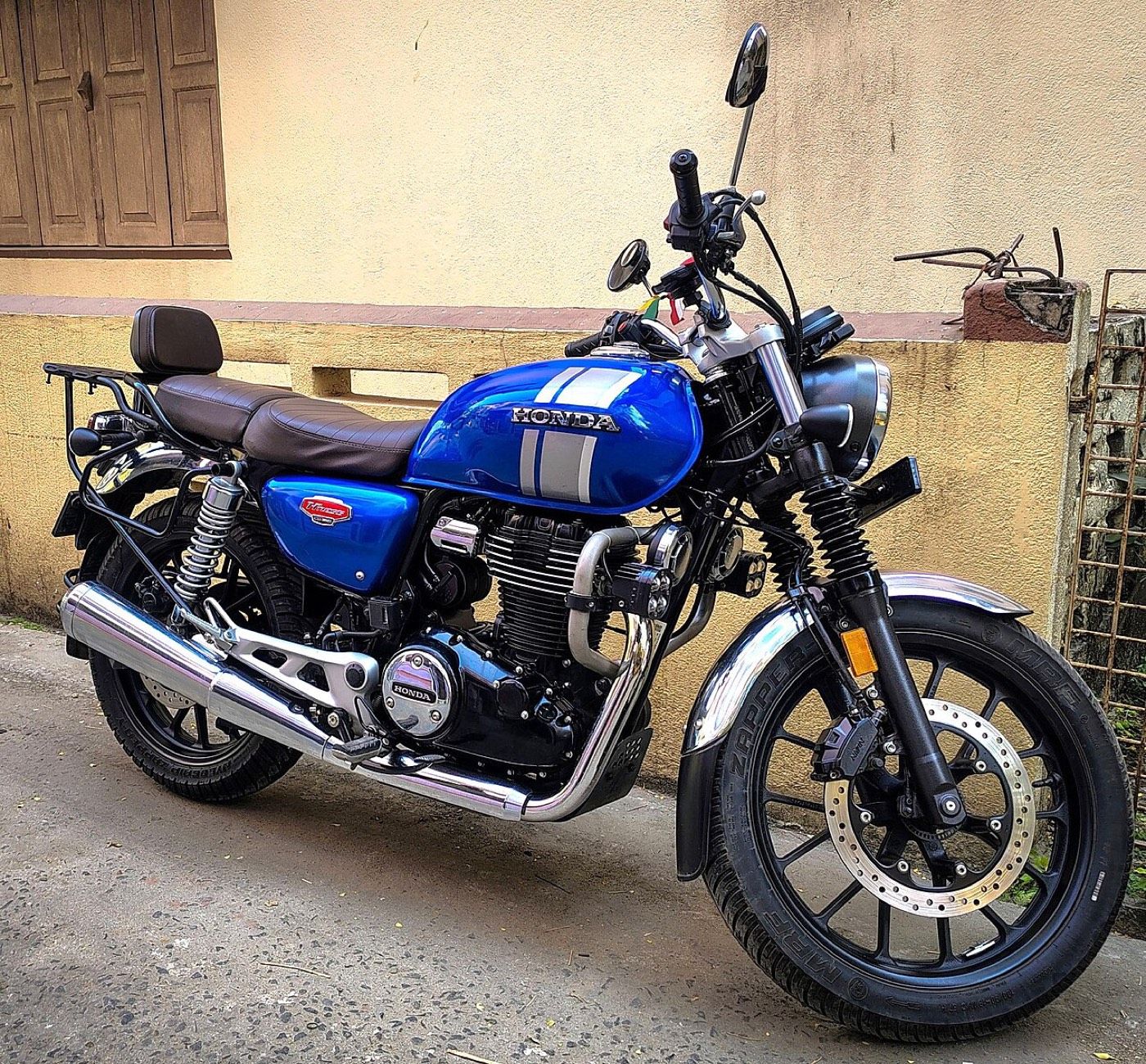
Firstly, the similarities with the H’ness CB350 are evident in the shape of the fuel tank and the LED headlamp. However, the dual-tone black-and-yellow paintwork looks attractive. While the headlamp uses a matte-black ring instead of chrome, it is flanked by new LED turn indicators that seem to have been plucked off the Honda Hornet 2.0. The side panel is new as well, and thankfully the awkward H’ness badge is not there, replaced with a nicer CB350 RS badge.
The side profile also reveals the motorcycle’s predominantly black theme, with only a little chrome pepper on the exhaust shield, handlebar and mirrors.
Is it a scrambler?
This motorcycle appeals to your senses the moment you look at it. Now, the H’ness looks nice, but it doesn’t make you go wow. This motorcycle here, with a 17-inch wheel, a fat tyre, the short and stubby tail section, the raised exhaust, or the dual-tone paint on the test bike — all of these combine to give it a nice, purposeful stance. And I think Honda has nailed the design.
But don’t let the wide block pattern on the tyres, the fork guards and the new metal bash plate that’s attached to the bottom of the frame fool you into believing that this is a scrambler. Because it isn’t. And neither is it a café racer. Now it may seem that the CB350 RS is suffering from an identity crisis because it can’t be classified as a type of motorcycle. But let’s just call it a very good-looking 350cc street motorcycle.
Price and features
As far as fit and finish is concerned, we’ve got no complaints. But considering the extra money Honda is charging for the RS, you may feel a little shortchanged after looking at the features list.
The Bluetooth connectivity module and the Type-C USB charger that are present on the H’ness CB350 DLX Pro variant are missing on the RS. While the USB port can be added as an accessory, there is no way to integrate Bluetooth connectivity. Then why is Honda charging nearly ₹10,000 over the base H’ness?
The company says that the new grab rail, fenders, fatter tyre and metal bash plate account for the additional input costs. It was launched at ₹1.96 lakh, ex-showroom, pan-India.
Ergonomics
Unlike the Honda H’ness CB350, where you get this feeling that you’re sitting on top of the motorcycle and it feels a little more commuter-ish, the CB350 RS riding position feels a lot nicer, sportier and more connected. The footpegs are a little rear-set and the handlebar is set a little more forward than on the H’ness CB350, and along with this slightly scooped seat you sit into the motorcycle, which enhances your sense of involvement.
And with the connection, I could also easily see myself touring on the CB350 RS without too much fatigue, even after spending long hours in the saddle. The seat height is also the same as on the H’ness CB350, but there’s a lot more room for the rider. That comes at the cost of space for the pillion, though.
The seat and the material they’ve used — this material is going to be a pain to maintain in our dusty environment. The other issue I’ve got is with the mirrors, because they show more of my arms and less of the traffic behind me.
Then there’s the annoying placement of the horn switch, which means you can’t find the button when you need it the most, especially to warn someone of your presence. But I’m okay to let that pass, because the riding experience makes up for it.
Engine and performance
This long-stroke single-cylinder engine is in the same state of tune as the H’ness CB350’s engine, and Honda hasn’t even tinkered with the internal gearing or the final drive ratio. This means you’ve got the same tall gearing, and it comes as no surprise that the performance is closely matched.
Despite the RS weighing 2 kilograms less than the H’ness, the fuel economy is marginally better with the CB350 RS, managing to squeeze about 1.5kmpl more in the city and on the highway, for a total mileage of 35km/l. But that could simply be down to the time of day and traffic conditions.
The tall gearing suits the sporty intent of this motorcycle. In fact, with the way you’re seated, you get into this frame of mind that you want to ride in a sporty manner. So you don’t mind shifting gears constantly to stay in the powerband. And given its smooth engine and the slipper clutch, that only adds to the riding experience.
You also won’t mind this counter-balanced engine’s character at high speeds. That said, a little more top-end performance would have been nice, and the tall gearing still compromises the drive on uphill sections. One of the probable ways of solving this issue could be altering the gearing by fitting a slightly larger sprocket at the rear.
Exhaust
The exhaust note also gels with the entire character of this motorcycle, as it’s got this thump low down in the revs, and it sounds sportier and raspier as you build the revs.
Underneath the bodywork, the Honda CB350 RS has the same half-duplex cradle frame as the H’ness, while the suspension units and steering rake angle are identical as well. The only major difference, as we mentioned, is the switch to a 17-inch wheel at the rear. And despite the block-pattern MRF Curved tyre’s design, the handling is pretty neutral and planted. The grip levels are enough, and in fact you can also ride this motorcycle down the trail without any bother. That said, I wouldn’t push these tyres when I’m out riding on a wet surface.
Riding aids
The switchable traction control may seem like overkill on a 21.1 horsepower motorcycle, but new rider buyers won’t mind the system being there to prevent unnecessary wheel spin on slippery surfaces. The ride quality at low speeds is a little stiffer than the competition, but it remains composed as the speed rises.
It is pretty good at isolating big potholes as well, and you won’t mind maintaining a fair clip over bad roads. The brakes leave no cause for complaint either, and the ABS is well-calibrated and does not intrude unnecessarily.
Conclusion
While a lot is going for the Honda CB350 RS, what could turn out to be a spanner in the works for this motorcycle is the limited BigWing sales and service network in India. While the number is steadily increasing, accessibility remains a concern at the end of the day.
I think I liked riding the Honda CB350 RS, given its sporty intent in the ergonomics. The way it’s styled, the way it rides and handles, the smooth engine — all of these factors come together to offer a much more wholesome riding experience.
And I think, for the extra money that Honda is charging over the H’ness CB350, it is money well spent.
A note added in 2026
Where the 35kmpl came from. That figure was the author’s observation over a short first ride, and the article itself immediately questions it — “that could simply be down to the time of day and traffic conditions.” It is preserved with that doubt attached. It is not a certified mileage figure, and it is not published as one in this page’s structured data.
Honda’s 17-inch-versus-19-inch wheel note above matters more than it looks: the RS and the H’ness differ in exactly that way, which is why the sentence that contradicted it was treated as the error. The current MotoSutra record for the donor bike is the H’ness CB350. There is no CB350 RS catalogue record, so this 2021 first ride is the only place on the site that the RS variant is discussed.