Road test
Hyundai Creta 2020 review: better than before, driven on the 1.4 turbo DCT
MotoSutra’s 2020 road test of the all-new Creta — the DCT that shifts more cleanly than the Seltos it shares an engine with, torque steer out of corners, a back seat that matters more than this one, the three-stop panoramic sunroof, and why the author still did not like how it looks.

Editor & Publisher
This is MotoSutra’s own road test of the all-new 2020 Hyundai Creta, written and published by Rahul Singh in October 2020 and reproduced from an archived copy of the original page. It tests the 1.4-litre turbo petrol DCT SX(O), a powertrain that is no longer the one most Creta buyers choose. It predates our current testing method, pricing treatment and rating system, so it carries no MotoSutra score; the 140hp and 242Nm figures are what the article reported.
Hyundai Creta overview
Lots of teasers, a big unveil at the Auto Expo, an exterior walk-around, an interior walk-around — so much has been said about this car that it needs no introduction, and lots of people were looking forward to the new Hyundai Creta. But what most people don’t know is how it drives.
Well, that’s exactly what I’m here to tell you about today. We’ve got the 1.4-litre turbo petrol DCT.
Hyundai Creta driving experience
The new Hyundai Creta has expanded the number of variants offered, with multiple engine and gearbox combinations. The one we’re driving today is the 1.4-litre turbo petrol with the 7-speed DCT automatic, in the SX(O) variant. This 1.4-litre turbo petrol, incidentally, only comes with the automatic option.
The engine is one that is shared with its sibling, the Kia Seltos, and it produces the same 140hp and 242Nm of torque. It’s a nice, sporty engine that picks up speed effortlessly, and the gearbox is quick to respond too, so if you’re looking for performance, the Creta offers it up well.
The DCT is smoother than it is in the Seltos. It transitions between gears in a much cleaner manner and it doesn’t have that aggressive clutch release at the start-off. However, when you suddenly press down hard at low revs, or in Sport mode, it does get snappier.
You have a variety of drive modes to switch between. Sport gives you the most fun factor; Normal is great for city driving; and Eco dials it back. While there’s a marked difference in Eco mode, it doesn’t dull the performance to a level where you’d never use it — for city commutes it’s quite good. The various modes let you get the best out of the performance depending on what you’re aiming for. With the AC on, performance and transmission characteristics change through the modes too: the gears shift up much quicker in Eco, and in Sport it holds on to the gear.
Sport mode can also be accessed by shifting the gear lever into manual mode, but the game-changer is the paddle shifter. This gearbox works well — smoothly, efficiently — but when you want that extra bit of spirited driving, what’s nice is having the paddle shifters. It makes it feel more sporty and fun, and it’s a welcome addition.
So the engine offers pleasing performance, and it does that in a most refined manner, but it does get a little vocal as you push it harder. Use it with a light foot in city traffic and you won’t notice a thing. In fact, cabin insulation is really good, cutting out the world outside, and as a result the new Hyundai Creta experience feels premium.
This feels like a more mature product, and that’s in more areas than one. The road manners have also changed with this new platform, shared with the Seltos: it feels more solid, and like a bigger car. It’s not up to the mark of some of the European products, but it is largely improved.
Now, on a winding section of road, what I notice is that this feels so much taller than before, but it is much better planted and goes around corners much nicer, with lots of grip. So yes, there’s more fun factor in the Hyundai Creta now; it’s more enjoyable to drive, especially with this 1.4-litre turbo petrol engine.
However, it does have some torque steer, which will be felt if you accelerate hard out of a corner. And the steering veers towards being on the lighter side for better manoeuvrability at low speeds, which takes a little away from the confidence when you’re driving fast. But that’s the feeling around corners. On a highway, in a straight line, it feels really good; stability at high speeds is also really good, and that inspires a lot more confidence. And the brakes are much better — the experience behind the wheel of the Creta is much more enjoyable.
Hyundai Creta interior
But India is a market where the back-seat experience often matters more than the front, and the back seat of the Creta is a really comfortable place to be.
There’s a good amount of legroom, even for tall people. The seat itself is well-cushioned, with good under-thigh support — nice and comfortable — and a nice recline angle to keep you comfortable. Here you have the central armrest, the window shades, a slot for your phone, the USB port, the AC vents and bottle holders, so yeah, there’s loads to keep you comfy as well. Good visibility all around; you sit nice and high. And of course, since there’s a panoramic sunroof, it really opens it up and makes it nice and airy. Despite the sunroof there’s a good amount of headroom. The third passenger can be squeezed in as well, though the console and the phone storage area do eat into the legroom.
Talking of that central console: the air-purifier indicator is on top of the console, in a place where it’s hard to read — unlike in the Kia, where it’s in an easier-to-read place. However, the cushioning of the seat itself is much better than the Kia Seltos’.
Headroom is a little less because of the sunroof, but not to a point where it would make a difference to tall passengers. Back-seat passengers of the Creta will be comfortable, because the ride quality is good. It rounds off bumps and potholes pretty well and it’s got a nice pliancy to the ride; the suspension does tend towards the softer side, and you will get moved around on your seat a lot more on uneven sections of the road, especially at higher speeds. But it’s still a large improvement from before, and for city use it’s good.
Hyundai Creta exterior
Well, we’ve covered everything about how the Creta is on the go, so let’s stop and take a look at it, and see what it offers in terms of features.
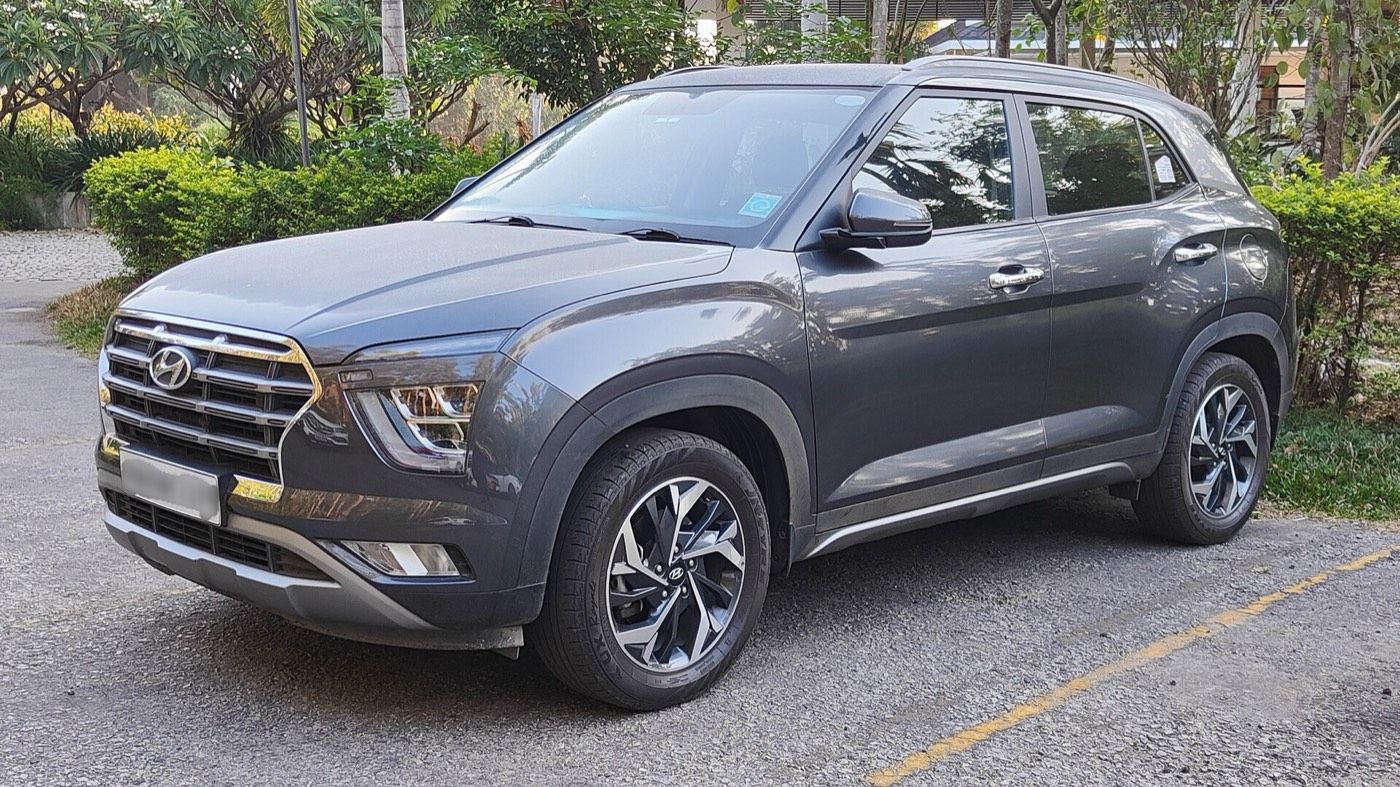
The Hyundai Creta looks have drawn a lot of attention, and not always in a positive manner. It’s a visibly larger vehicle with good proportions, thick creases over the arches, broad shoulders, and a roofline that ends in a silver accent at the C-pillar. So it still does have that large-SUV feel, which was the appeal of the first Creta.
However, there are a lot of quirks in the styling — like the flat nose that houses a large grille and a three-part split lamp, and the rear, which is very rounded and carries over the three-part split lamp, mirroring the front design. Overall it’s not as appealing as its predecessor, and the way it looks will polarise opinions. I, for one, don’t like the way it looks.
Now, while the exterior looks may be polarising — some people may like it, some people may not — I’m sure once everyone gets inside the Hyundai Creta, they’re going to like the way this looks. It looks nice on the inside.
This version that I have has these red, sporty accents around the AC vents. There’s also lots of chrome highlights around the inside to lift it, nice matte-black material here on the central console, lots of storage areas and cubbyholes. The seats themselves are large and comfortable. The dials are crisp, clear, clean; the tach is a bit small and I would have liked a larger one. The infotainment screen is large, lays flush, with crisp, clear graphics as well. The top of the dash and the door panels do have some hard plastics, but on the whole it’s a nice-looking interior.
And of course you have this panoramic sunroof, though it’s a bit fussy to use. To have only the screen open without the glass is a three-stop procedure: tap the button, wait till the glass opens, tap it again, and then push the button back to fully open the screen. And of course there’s a load of other features.
Conclusion
The Hyundai Creta had a great run till its sibling, the Kia, came and shook up the segment and became the benchmark. Well, the new Creta has taken a quantum leap ahead. In fact, it is improved in every area. It offers you much better interiors — far more luxurious — it comes packed with features, there’s a wide variety of variants, and it’s even more fun to drive now. And of course it all comes in a package that offers you value. So the Creta is back with a bang.
A note added in 2026
This is not the current Creta review. MotoSutra reviews the car on sale today separately, at Hyundai Creta review, under the method and pricing rules this site uses now, with a rating. The two are kept apart deliberately: this test is of a 1.4-litre turbo DCT SX(O) from October 2020, that one assesses a different car, and neither has been edited to agree with the other.