Specs & analysis
Skoda Karoq India 2020 first drive: the CBU that previewed Skoda 2.0
MotoSutra’s 2020 test of the Karoq, the first Indian drive of the Volkswagen Group’s 1.5 TSI Evo: 150hp, 250Nm, a measured 0-100 in 10 seconds flat, the digital cockpit and Yeti-like ride, and why a 25-lakh tag sat beside Seltos-sized steel.

Editor & Publisher
This is MotoSutra’s own first drive of the Skoda Karoq, written and published by Rahul Singh in August 2020 and reproduced from an archived copy of the original page. It is not the later Karoq page on the same legacy URL: that was a different, re-yearéd article, and the two were never merged. This test predates our current methodology, pricing treatment and rating system, so it carries no MotoSutra score, and the 0-100 result and price below are the 2020 article’s own.
Skoda Karoq review
Skoda was the first to show Indians, way back in the day, that you didn’t have to stretch your budget to Mercedes-Benz levels to have a premium, well-built, well-engineered car — and that earned it a reputation as a very aspirational carmaker. But that was a long time ago. These days there are a lot more players in the market, and those brands offer you a smaller, more affordable car than they did before. This is the new Skoda Karoq, coming to claim its place.
Moreover, Skoda’s reputation kind of took a hit when it came to after-sales, although that is on the mend. And the product lineup has since sort of stagnated into four products, most of which are kind of niche. That’s all set to change, though, as the Karoq has taken the reins for the whole Volkswagen Group in India. And though the big revolution is coming in 2021, it has started right away with this.
Say hello to the Skoda Karoq, an SUV that will sit in Skoda India’s line-up below the Kodiaq and above the upcoming Hyundai Creta rival. But, unlike its two SUV siblings, the Karoq will be a full CBU import. That means it will attract heavy import duties, which means it will likely be priced higher than its size suggests. So while it’s about the size of a Kia Seltos on the outside, its price will likely make it a close rival in the likes of the Jeep Compass. But if you think it’s coming to battle with one arm tied behind its back, think again, because Skoda has a few clever tricks up its sleeve with this one.
Skoda Karoq exterior
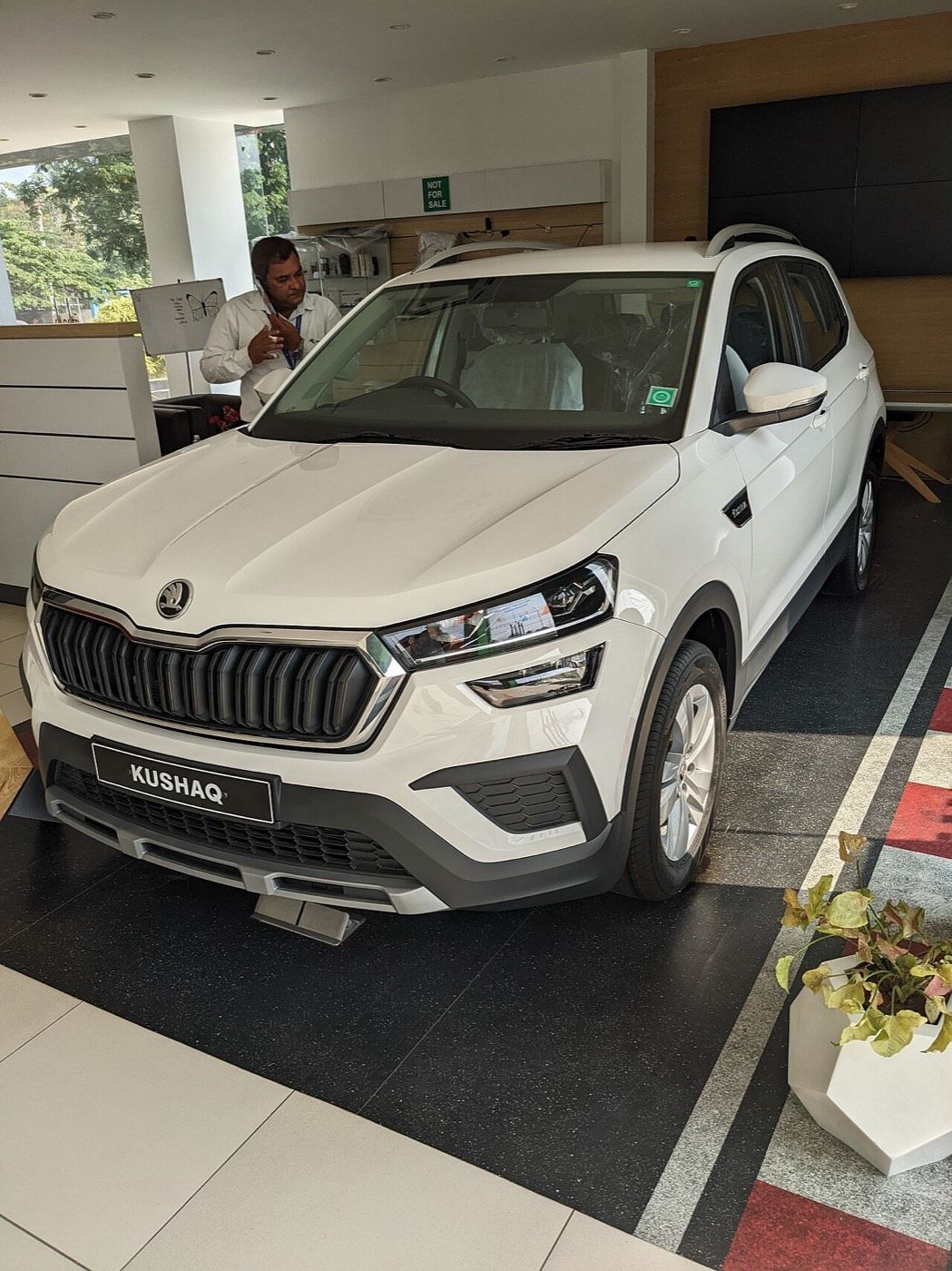
I quite like the way it looks. It doesn’t have the quirkiness of the old Skoda Yeti for sure, but it’s got that understated elegance that people love about Skoda. There is a resemblance to the Skoda Kodiaq, but it has more conventional SUV proportions. The front end is a little less extravagant, with a simpler design for the LED headlamps and bumper. But over to the side, you’ll be happy to find prominent character lines and a sharp set of 17-inch alloy wheels.
At the rear, you get the new staple of large Skoda lettering across the tailgate, and I particularly like the shape of the LED tail lamps. And while we’re talking about the back, let’s talk about the boot, which is quite generous at 520 litres. The seats can be dropped at the pull of a lever to free up 1,630 litres.
And there are a few of Skoda’s clever touches, like bag hooks, Velcro luggage separators, and even a magnetised LED flashlight to help you change your tyre in the dark. And yes, there is a full-size spare tyre.
Skoda Karoq interior
Time to tell you what the back seat is like. Now, as I’m sure you’ve guessed from the exterior dimensions of this car, space in the back seat of the Karoq is good but not one of this car’s USPs. I’m 5’10” tall and I’ve got enough knee room and about enough headroom. But I suspect taller passengers might only find it adequate. They might also find that the backrest is a little bit upright. Apart from that, this is a great seat — very supportive and very comfortable.
It’s placed high enough that you get a good view out of the front, plus there are these quarter glasses behind me that let in a lot of light. And if you want more light still, there’s always the massive panoramic sunroof. So it’s more comfortable in the back seat than its exterior size would suggest.
But what about if you’re sat in the front? Now, this being a Skoda, as you might imagine, quality levels inside here are pretty high. And to drive that premium point home a little further, they’ve added quite a few embellishments, like this brushed aluminium strip down the passenger side and chrome around the AC vents. And my favourite, the digital instrument cluster, which is a highlight of this car.
Moreover, it’s a very practical cabin with loads of storage spaces: one down the centre tunnel for your mobile phone — although there’s no wireless charging — and this nice sliding armrest that reveals a big bin with cupholders that can be removed. If you don’t want them, there are also big door pockets and even a little storage bay up on the dashboard.
They’ve also loaded it up with equipment, with the likes of a powered driver seat with memory, an 8-inch touchscreen and dual-zone climate control.
Features
- Adaptive full-LED headlamps
- Auto headlamps and wipers
- Digital instrument cluster
- 8-inch touchscreen
- Apple CarPlay and Android Auto
- Panoramic sunroof
- Powered driver seat with memory function
- Tyre-pressure monitoring
- Ambient interior lighting
- Keyless entry and go
Yes, while we would have liked to have seen things like wireless phone charging and three-zone rather than two-zone climate control, you have to admit they’ve chosen to include several big-ticket features like the power driver seat, the panoramic sunroof and digital dials. On the safety front there’s the usual suite of electronic aids and nine airbags.
And with that, let’s hit the road and see what the Karoq is like to drive.
Skoda Karoq test drive
Before anything else, the first thing you notice is how comfortable these front seats are. The driver’s seat is power-adjustable including four-way lumbar support, so there are many ways you can fit around to get into the perfect driving position. It even has a memory function. The next thing you notice is that visibility is rather good.
The dashboard is nice and low, and the A-pillars are quite thin, so you get great visibility forward. And if you look in the rear-view mirror, you get a great view of the large windscreen at the back. This is our first taste of the Volkswagen Group’s 1.5-litre direct-injection turbocharged petrol engine, and first impressions are rather good.
It’s very refined low down, and as long as you keep it under 2,000rpm, it stays that way. You might hear a little bit of a buzz once you cross 2,000rpm, but it’s not too intrusive. It is when you get closer to about 4,000 or 5,000rpm, running it out in this car, that it gets quite booming — but that’s only if you’re on the limit when you reach that level, and that seems rather unlikely because this is quite a relaxed engine.
Performance figures
It encourages you to drive in a relaxed manner. It doesn’t have a serious punch in the mid-range, nor does it rev like an absolute maniac. You do get a bit of a step up in power in the mid-range, as you’d expect from a turbocharged petrol engine, but it’s not a solid hit that makes you want to go for the accelerator. This guy is best driven at about eight-tenths. Still, it does make 150 horsepower and 250 Newton metres of torque, so performance is pretty decent — against our testing equipment it did 0 to 100kph in a respectable 10 seconds. Kick-down acceleration was pretty swift too.
Helping here is the 7-speed dual-clutch automatic, the Volkswagen Group’s DSG, which does its part to make the driving experience smooth at lower speeds and shifts quick at higher speeds.
On the dynamic front, in true Skoda fashion, they’ve managed to nail an excellent blend of the ride and handling. It’s not perfect in either aspect, but then you couldn’t complain about either of those aspects either. The ride might have a very slight firm edge, but it still can’t be called uncomfortable. And the upshot is that you get tremendous stability. You encounter a rough road and the Karoq’s suspension pummels it into submission, with little interference inside the cabin and a confidence that reminds you of the old Skoda Yeti.
Likewise, the handling isn’t pin-sharp, and yes, the steering can feel a bit mushy in the corners when you’re pushing it hard. But for the most part that means it’s easy to drive, and that’s what matters most. And because of the way the suspension is set up, the body control is good. So the 2020 Skoda Karoq has a nice middle-of-the-road driving dynamic that should suit both the enthusiast and the everyday driver fine.
Price
The article priced the Karoq at ₹25 lakh, ex-showroom India.
Conclusion
Skoda’s big India 2.0 plan may only be kicking off in 2021, but it’s got a few products to tide us over until then. The Karoq is an excellent start. Sure, those looking for a good price-to-size ratio in their SUV might want to look elsewhere — but then Skoda customers tend to prefer cars with a bit more substance to that end. They’ve made sure to spec the Karoq well, with all the desirable equipment buyers want, but they don’t seem to have overdone it either, leaving out some non-essential equipment that you would find on the European model.
Moreover, they’ve left out all-wheel drive, which seems fine for an urban SUV like this. But what this points to is a price that might be more aggressive than we thought. The new 1.5 TSI engine isn’t the most exciting, but it gets the job done. What Skoda fans will appreciate are the quality interiors, the all-conquering ride, the tidy dynamics, the solid build quality and the right price. It may have what it takes to jumpstart Skoda back to the glory days of old.
A note added in 2026
There were two Karoq articles at this address. The legacy URL later carried a different, re-yearéd piece about the 2021 model. This page reproduces the 2020 first drive from the capture named above, and the two have not been merged or reconciled — where they disagree, they are two separate documents written months apart.
Slightly less obvious consequence: because the later article is gone from the live site, no current MotoSutra page covers the Karoq. The Skoda model the site does carry is the Kushaq, and the 1.5 TSI Evo introduced here turns up again in the 2020 Volkswagen T-Roc test recovered alongside this one.