Road test
TVS Apache RTR 200 4V 2021 review: what the three ride modes change on the road
MotoSutra’s 2021 test of the updated Apache RTR 200 4V: preload-adjustable fork, adjustable levers, rain/urban/sport modes, and what our braking and acceleration runs showed — alongside the specification and feature lists the original article published.

Editor & Publisher
This is MotoSutra’s own 2021 test of the updated TVS Apache RTR 200 4V, written and published by Rahul Singh in June 2021 and reproduced from an archived copy of the original page. It predates our current testing method, pricing treatment and rating system, so it carries no MotoSutra score. The braking and acceleration observations below are what the 2021 article reported and have not been re-measured since; the specification tables and the Smart Connect and GTT sections were compiled from TVS’s published material rather than measured by us, and the prices are June 2021 ex-showroom figures, not a quotation.
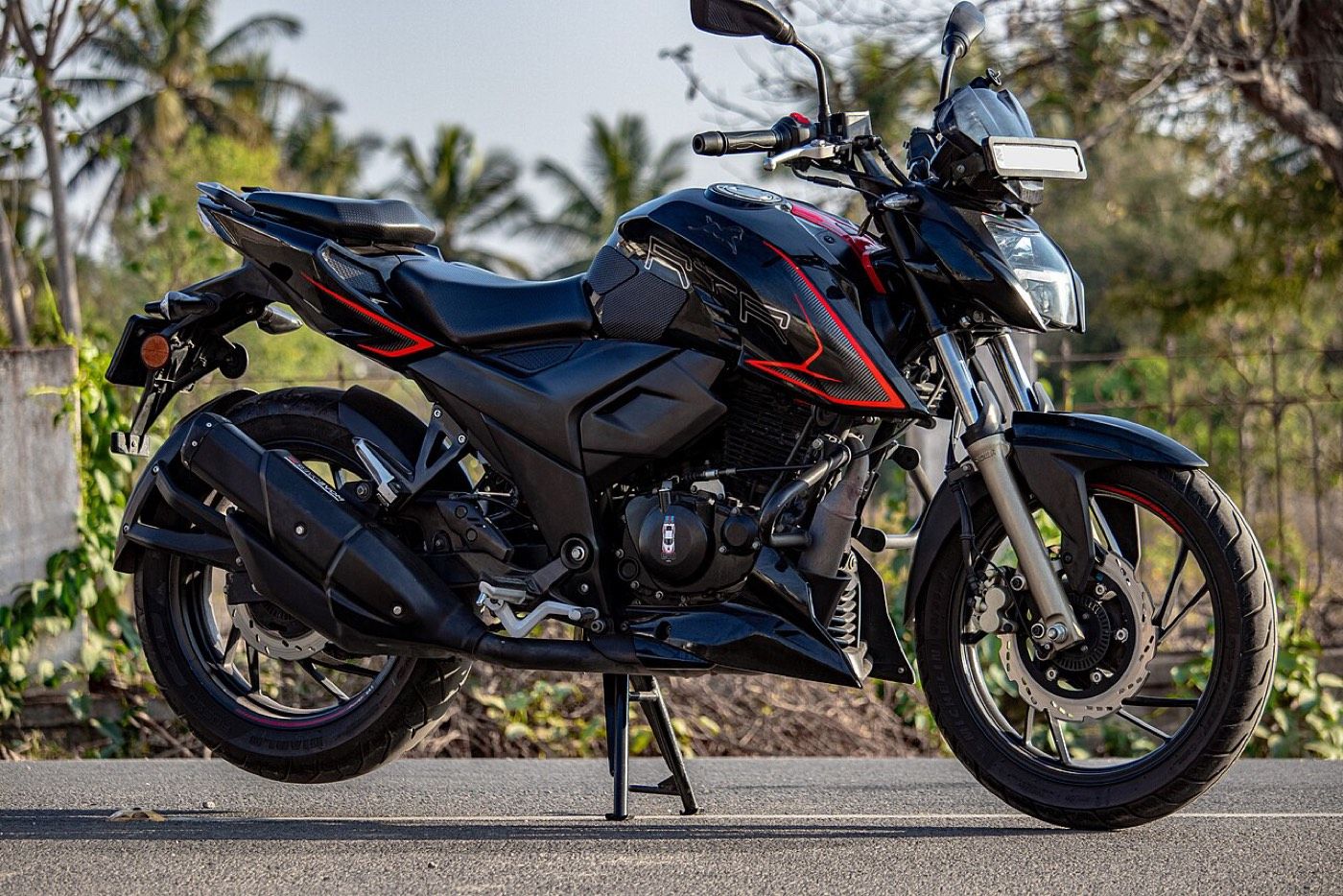
The TVS Apache RTR 200 4V has always been one of our favourite bikes in the segment. Early last year it got an update to comply with BS6. And that update also saw a minor redesign, particularly to the front end and to the graphics schemes. More recently, TVS added some features to this. And some of them we’ve never seen in this segment before.
Specifications of the TVS Apache 200
Engine and transmission of the TVS Apache RTR 200 4V
The engine of this bike is carefully designed and developed for good sports efficiency. You get a 197.75cc displacement engine in this bike that generates 21PS @ 7,000rpm of horsepower and delivers 17Nm @ 6,500rpm of torque. This bike additionally comes with BS6 emission norms, so the piston utilised in this engine is slightly lighter and there is also a catalytic converter on the exhaust system. This engine is fed by the fuel-injection system to improve its performance.
| Engine | 4-stroke |
| Valves | 4 |
| Power | 21PS |
| Torque | 17Nm |
| Gears | 6 |
| Transmission drive | Chain |
| Chain | Brass coated |
| Cylinders | 1 |
Brakes, tyre and suspension
The first of these updates is to do with the suspension. Now, while this Apache still uses a conventional telescopic fork, it is adjustable for preload.
Every suspension system has a usable range of motion. And when you add load to the motorcycle in the form of a rider, luggage or pillion, the suspension compresses. And it may eat into that range of motion, giving the suspension less room to move.
What preload adjustability essentially allows you to do is raise or lower the suspension, so it doesn’t eat into that usable range.
This system is an opportunity to fiddle around with the basics of suspension. Setting sag is how much the bike sinks under its own weight, and with the rider’s weight.
| ABS | Yes |
| Disc | Yes |
| Tyre | Tubeless |
| Wheel | Alloy |
| Front suspension | Fork |
| Rear suspension | Mono-shock |
And, while we’re on the subject of adjustability, there is another element of the motorcycle that can be tweaked for better ergonomics. This RTR 200 4V now gets adjustable brake and clutch levers.
In our brake test, the Apache stopped nearly 2 metres later in rain mode, while the distances in sport and urban were quite close to each other.
The braking performance is better than before, with TVS having updated the system to offer a better bite in comparison to the BS6 model that we tested a few months ago. This Apache came to a halt from 60 kilometres per hour a couple of metres shorter.
Electronics
| Instrument console | Digital |
| Fuel injection | Yes |
| LED headlamps | Yes |
| LED taillight | Yes |
| Device connectivity | Yes |
| Turn signal light | LED |
TVS riding modes
The second big update is that this Apache now has riding modes. Three of them: rain, urban and sport.
Sport mode gives you access to all the 21 horsepower that this engine has to offer, with ABS being the least intrusive in this setting.
In rain and urban mode, power goes down by about 3.5 horsepower, with torque down by 0.7Nm. The difference is in how the ABS intervenes, unsurprisingly. The ABS is most intrusive in rain mode. The urban mode offers a middle ground between rain and sport.
We tested both the acceleration and the braking in the different modes, and found that the bike takes an additional 0.7 seconds to get to 60 kilometres per hour in the lower power. However, that gap extends to nearly 4 seconds in the sprint to 100. On the flip side, running the bike with the lower power output in rain or urban mode did return better fuel efficiency.
Smart Connect
This feature, introduced by TVS on this bike, is a remarkable move from the rider’s point of view. The function is meant to improve the riding experience. So what is Smart Connect? In this feature, riders link their smartphone with the bike through Bluetooth connectivity, and there are numerous functions you can access through it.
- The first of them is navigation on the fully digital instrument console.
- The system is designed to show several stops along the route you are navigating, which is extremely practical during long trips.
- When fuel is low it will immediately navigate you to the nearest filling station.
- The Smart Connect app gives detailed information about the bike’s performance.
- The most useful attribute is the crash-alert function: it identifies the exact location of a crashed rider and sends it to an emergency contact.
- Smart Connect also carries SMS and call notifications on the console.
- A welcome alert on the console with your name is an interesting function on this bike.
GTT technology in the TVS Apache RTR 200 4V
The brand-new Apache comes with BS6 emission norms, and according to that there is a fuel-injection system introduced in this bike. The small breakthrough feature TVS is offering here is known as GTT — Glide Through Traffic.
This is meant to give you smooth, controlled movement in urban areas, where you move the bike off with a smooth release of the clutch lever and no throttle input. Doing this improves fuel efficiency.
Price
TVS has refined the structural elements of the chassis, and this has resulted in a 1kg loss in weight. With this update, this Apache now costs only a couple of thousand rupees more than before. This machine can be yours in only ₹1.29 lakh — it is real value for money.
| Single-channel ABS | ₹1,29,315 |
| Dual-channel ABS / R-mode | ₹1,34,365 |
Ex-showroom prices as published in June 2021.
Conclusion
Recently TVS also introduced these features on the single-channel ABS variant. And that bike costs ₹5,000 less, which isn’t a lot of money. And in our opinion, you should consider paying a little extra for the added safety that this dual-channel variant brings.
A note added in 2026
Not every section of this page is a test result. The braking and acceleration material — the Apache stopping nearly 2 metres later in rain mode, the shorter stop from 60kph against the earlier BS6 bike, the 0.7-second and near-4-second gaps between the power modes, the better economy in rain and urban — is what MotoSutra measured in 2021 and is preserved as published. The four tables, the Smart Connect list and the GTT explanation are not measurements. They came from TVS’s published material, and the original article is at its weakest there; read them as a 2021 specification summary rather than as findings.
The prices above are June 2021 ex-showroom figures from the archived page. They are not current, are not quotations, and are deliberately kept out of this page’s structured data.
TVS has since revised this motorcycle, and MotoSutra now carries a current catalogue page and a present-day review of it — the TVS Apache RTR 200 and the 2026 Apache RTR 200 4V review. That review is a different document with its own scores and its own prices, and this 2021 test is not part of it.